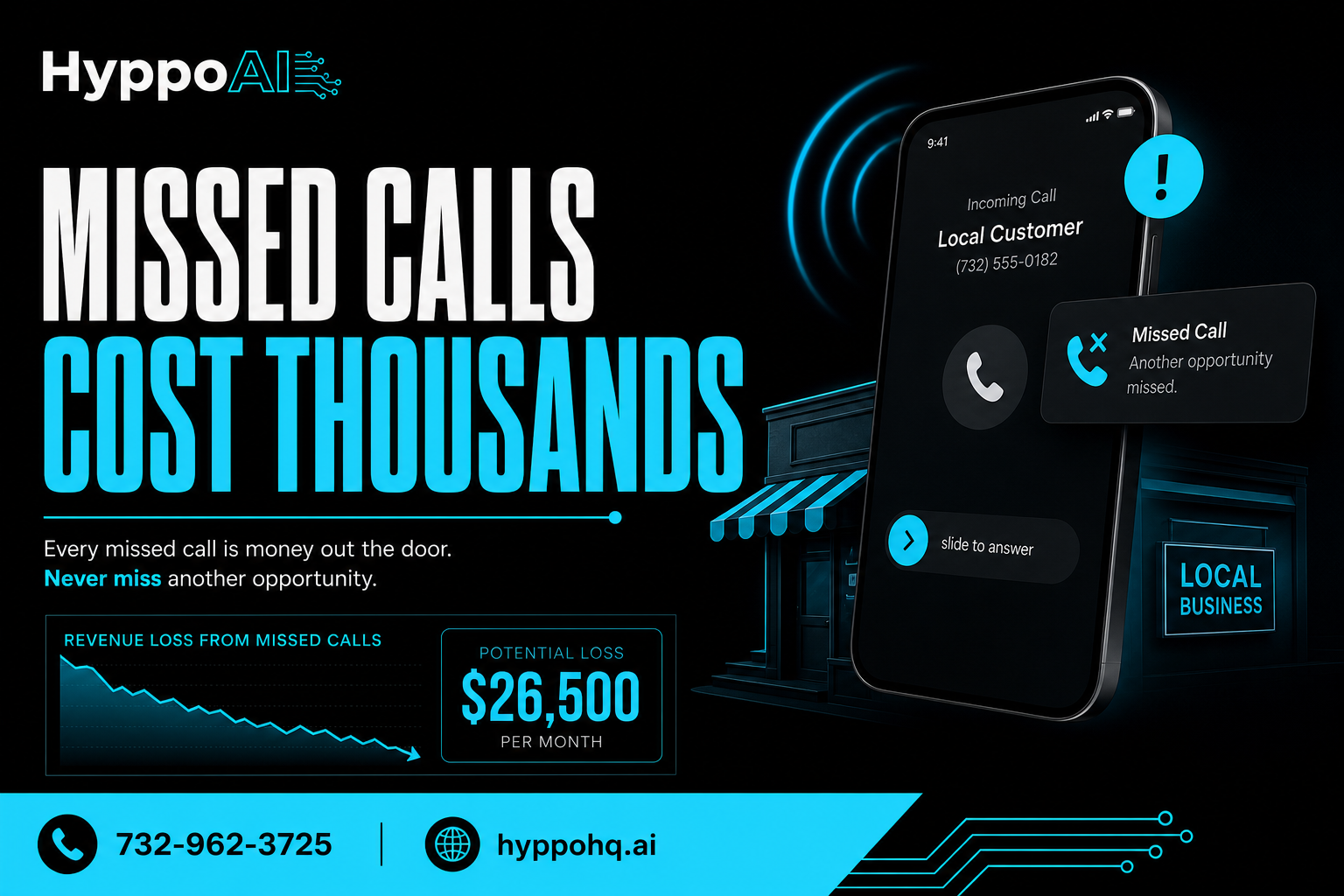
How missed calls quietly cost local businesses thousands
For many local businesses, the phone is still one of the highest-intent lead channels.
When someone calls, they usually need help now. They are not casually browsing. They are ready to book, ask for pricing, schedule service, or solve a problem.
That is why missed calls are so expensive.
The cost is rarely obvious on a profit and loss statement. It shows up quietly through lost bookings, abandoned quotes, weaker customer experience, and leads that call the next business on Google instead.
If you run a service business, medical office, home services company, law firm, or any local operation that depends on inbound calls, missed calls may be costing you thousands more than you think.
Why missed calls matter more than most owners think
A missed call is not just a missed conversation.
It is often a missed buying moment.
Local customers usually call when they are close to making a decision. They may have found you through:
- Google search
- Google Business Profile
- Local ads
- Referrals
- Social media
- Your website
In other words, you already paid for that attention somehow. Maybe through ad spend, SEO, time, reputation, or years of trust-building.
When the phone rings and nobody answers, that investment starts leaking value immediately.
The reality of local buyer behavior
Most callers do not wait long.
They do not leave a voicemail.
They do not fill out your contact form later.
They simply call the next business.
This is especially true for urgent or time-sensitive services like:
- HVAC
- Plumbing
- Electrical work
- Roofing
- Auto repair
- Legal consultations
- Med spas and clinics
- Cleaning services
- Property services
If a prospect needs help today, speed wins.
Where missed calls usually happen
Owners often assume missed calls happen only after hours. In reality, they happen throughout the day.
Common failure points include:
- Staff are already on another call
- Front desk is helping in-person customers
- Calls come in during lunch breaks
- The team is short-staffed
- Calls arrive after business hours
- Weekend inquiries go unanswered
- Peak season creates call overflow
- Spam filtering or routing issues cause delays
Even strong businesses with good teams deal with this.
The problem is not always effort. Often, it is capacity.
How missed calls quietly turn into lost revenue
The financial impact compounds fast.
Let us say your business misses just 5 qualified calls per week. If even 2 of those callers would have become customers, what is that worth over a month or a year?
For a business with average tickets of a few hundred dollars, the number adds up quickly. For higher-ticket services, the losses can be much larger.
The hidden costs behind every missed call
Here is what a missed call can actually cost:
- Lost first-time customers
- Lost repeat business
- Lower close rates from delayed follow-up
- Wasted ad spend from unconverted leads
- Reduced trust in your brand
- More negative reviews tied to poor responsiveness
- Less referral momentum over time
And there is another layer many businesses miss: operational drag.
When your team has to chase voicemails, return calls late, or sort through inconsistent follow-up, efficiency drops. That means more manual work and fewer clean handoffs.
Why voicemail is not enough anymore
Many businesses still rely on voicemail as the backup plan.
The issue is simple: voicemail creates friction.
Today, customers expect fast responses. When they hear a generic mailbox message, they often assume:
- You are too busy
- You are hard to reach
- You may not respond soon
- Another provider will be easier to work with
That does not mean voicemail has no place. It means voicemail alone is no longer a strong lead capture strategy.
In a competitive local market, responsiveness is part of the sale.
The compounding effect on marketing ROI
If you invest in marketing, missed calls hurt more than you think.
Every campaign is designed to generate attention and action. For many local businesses, that action is a phone call.
So when calls go unanswered, your marketing performance drops at the point where conversion should happen.
That affects:
- Cost per lead
- Cost per acquisition
- Return on ad spend
- SEO and local listing value
- Sales pipeline consistency
You may think you need more leads, when the real problem is that you are not capturing the leads you already have.
Signs your business has a missed-call problem
Some businesses know immediately. Others only notice after patterns start affecting revenue.
Watch for these signs:
- Frequent voicemails from new prospects
- Customers saying they could not reach you
- Calls clustering during busy periods
- Low booking rates despite strong traffic
- Front desk staff feeling overwhelmed
- After-hours inquiries going cold
- Paid ads generating calls but weak conversion
If any of these sound familiar, it is worth auditing your call handling process.
What local businesses should do instead
The goal is not just answering more calls.
The goal is creating a reliable system for capturing demand whenever it shows up.
Build a better response system
A stronger call workflow often includes:
- Consistent call routing
- Overflow handling during peak times
- After-hours response coverage
- Fast follow-up for missed calls
- Clear intake and qualification steps
- Appointment booking support
- CRM or lead tracking integration
This is where automation can make a measurable difference.
How AI can help close the gap
AI voice systems and AI receptionists are becoming practical tools for small and midsize businesses that cannot afford to lose inbound demand.
Used well, they can help answer calls, gather information, route urgent requests, and support scheduling when human staff are unavailable.
That means your business can respond faster without forcing your team to be available every second of the day.
What an AI receptionist can support
Depending on the setup, an AI receptionist may help with:
- Answering calls instantly
- Handling after-hours inquiries
- Capturing caller details
- Qualifying leads
- Booking or requesting appointments
- Routing calls to the right person
- Logging conversations for follow-up
The value is not just convenience.
It is consistency.
A system that responds every time can protect revenue, improve customer experience, and reduce the number of opportunities that slip through the cracks.
The smartest question to ask
Instead of asking, "How many calls are we missing?" ask this:
"How much revenue is tied to the calls we fail to handle well?"
That question changes the conversation.
It moves missed calls from being a minor front-desk issue to being a real growth and operations issue.
For local businesses, that shift matters.
Because once you see missed calls as lost demand, the need for a better system becomes obvious.
Final takeaway
Missed calls do not always look dramatic.
They rarely trigger alarms. They just quietly erode revenue, reduce marketing efficiency, and send ready-to-buy customers to competitors.
If your business depends on inbound calls, improving responsiveness is one of the simplest ways to protect revenue and create a better customer experience.
HyppoAI helps businesses explore smarter call handling with AI-powered systems built for real-world operations. Visit https://hyppohq.ai or call +17329623725 to learn how your business can capture more of the opportunities already coming in.
