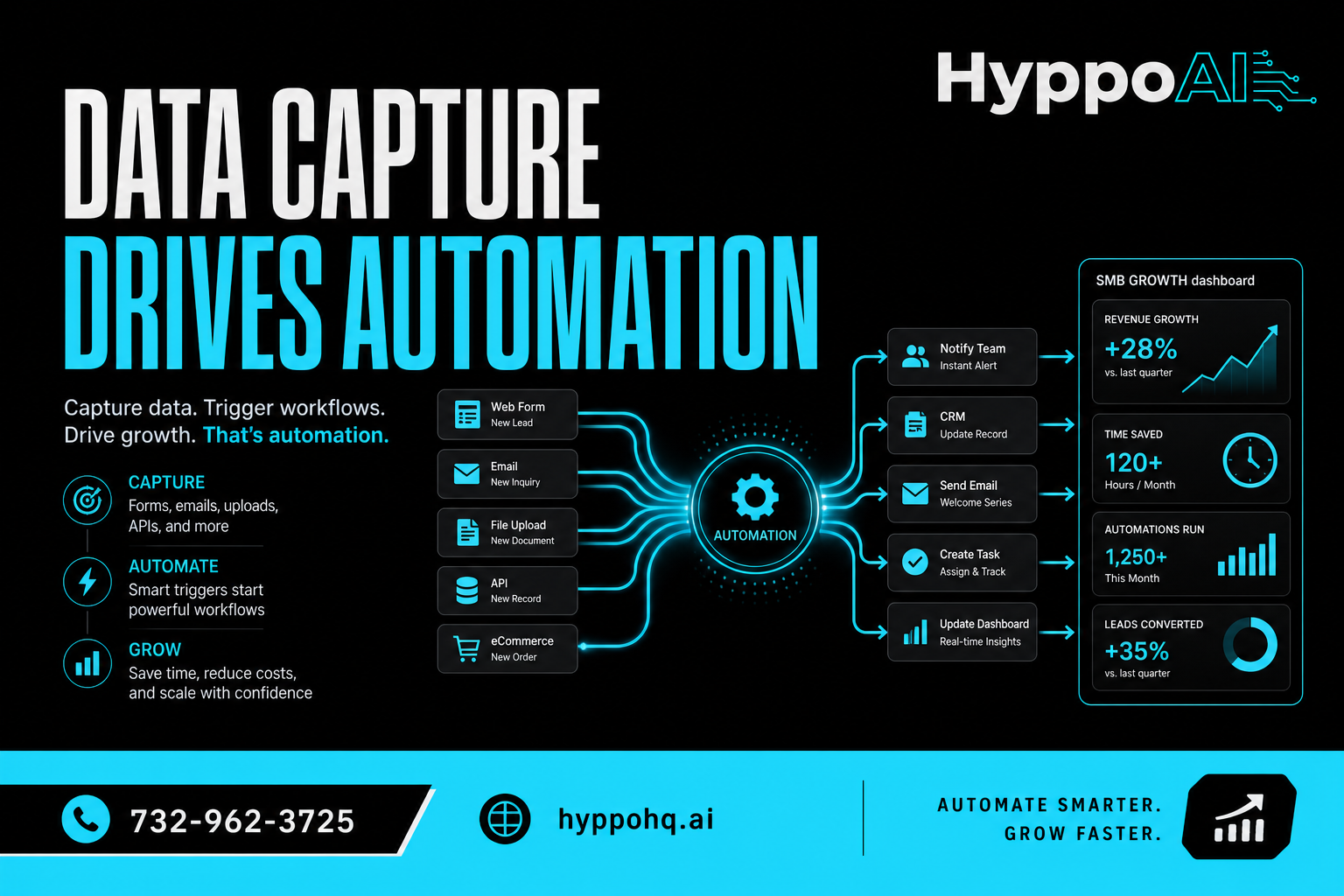
How data capture starts automation chains for SMB growth
Every automation chain starts with one thing: captured data.
If your business wants faster follow-up, fewer missed handoffs, and more consistent operations, the first question is not which tool to buy. It is whether you are capturing the right information at the right moment.
For SMBs, this matters because automation is only as strong as the input feeding it. When customer details, service requests, call notes, or lead intent are captured clearly, the next step can happen automatically. When they are not, work stalls, leads cool off, and teams end up patching gaps manually.
What data capture actually means
Data capture is the process of collecting information from a customer, lead, employee, or system so it can trigger the next action.
That information might come from:
- A website form
- An inbound phone call
- A text message
- A chatbot conversation
- A booking request
- A CRM update
- An invoice or payment event
- A support ticket
The key is not just storing the information. The key is structuring it so your systems can use it.
For example, a name and phone number sitting in an inbox is not very useful by itself. A name, phone number, service type, urgency level, and preferred appointment window captured in a usable format can immediately trigger follow-up.
Why data capture is the first link in the chain
Automation chains are sequences of actions that happen after a trigger.
A simple chain might look like this:
- A lead fills out a form
- The system captures the data
- The CRM creates a contact
- The lead gets a text confirmation
- The sales team gets notified
- A follow-up task is assigned
Without clean data capture, none of that works reliably.
That is why businesses that struggle with automation are often not dealing with an automation problem first. They are dealing with an intake problem.
No input, no trigger
Automation needs a starting event.
That event could be a submitted form, a tagged email, a completed call, or a new record in your CRM. If the event is inconsistent or incomplete, the chain either fails or requires manual correction.
Bad data creates bad automation
If a phone number is missing, a text cannot send. If the service category is wrong, the request goes to the wrong team. If duplicate records are created, reporting becomes unreliable.
Good automation depends on:
- Accurate fields
- Consistent formatting
- Clear trigger conditions
- Useful context attached to each entry
Common examples of automation chains starting with data capture
SMBs do not need massive enterprise systems to benefit from this. In most cases, a few high-value workflows can make an immediate impact.
Lead intake and follow-up
A prospect submits a request on your website. Their information is captured and used to:
- Create a CRM contact
- Send an instant response
- Alert the right rep
- Start a follow-up sequence
- Log the source for reporting
This reduces lead response time, which often has a direct effect on conversion.
Missed call recovery
A customer calls after hours and no one answers. If the call data is captured properly, your system can:
- Log the caller automatically
- Send a text acknowledgment
- Route the lead into a callback queue
- Notify the team the next morning
This is a strong example of how captured call data can prevent lost revenue.
Appointment and scheduling workflows
A customer books a service. That booking data can trigger:
- Calendar updates
- Confirmation messages
- Reminder texts or emails
- Internal prep tasks
- Post-appointment review requests
Again, the chain only works if the original booking details are captured correctly.
Support and service requests
When a customer sends a support message, structured intake can route the issue based on urgency, department, or request type. That means less manual sorting and faster resolution.
What good data capture looks like
Not all intake processes are equal. Good data capture is built to support action, not just record keeping.
Here are the traits that matter most.
It happens at the point of contact
The closer data capture is to the original interaction, the better. That reduces memory gaps, lost notes, and delays.
Examples include:
- Capturing call details during or right after the call
- Structuring website forms around decision-making fields
- Logging message intent from chat or SMS conversations
It captures the fields that matter
Many businesses either collect too little or collect too much.
The goal is to capture the minimum useful information needed to trigger the next step. That often includes:
- Contact details
- Request type
- Location
- Urgency
- Budget or job size
- Preferred timing
- Lead source
It is standardized
If one form says "service type," another says "job needed," and a third uses free text only, automation gets messy fast.
Standardized fields make routing, tagging, and reporting easier.
It connects to downstream systems
Captured data should not get trapped in one tool. It should move where it needs to go, whether that is your CRM, scheduling platform, help desk, or reporting dashboard.
Where SMBs usually get stuck
Most SMBs do not fail because they lack demand for automation. They get stuck because their intake process grew organically and now lives across too many disconnected places.
Common friction points include:
- Leads coming in through multiple channels with no unified structure
- Staff manually re-entering the same information
- Follow-up depending on someone remembering the next step
- Missing context between marketing, sales, and operations
- Inconsistent data formats across tools
When that happens, automation feels unreliable. In reality, the system is only reacting to inconsistent inputs.
How to improve data capture before adding more automation
Before building new workflows, audit the first step.
Ask:
- Where does new information enter the business?
- Which inputs trigger revenue-related actions?
- What fields are missing too often?
- Where does manual re-entry happen?
- Which follow-ups are delayed because context is incomplete?
Then simplify.
Start with one high-value workflow
Do not try to automate everything at once. Pick one chain where better intake will produce a clear return.
Good starting points are:
- New lead response
- Missed call follow-up
- Appointment confirmations
- Review request workflows
Define the trigger clearly
Every chain needs a clean starting condition. For example:
- New form submitted
- Call missed after business hours
- Estimate requested for a specific service
- Customer marked as completed in the CRM
Clean up the required fields
Make sure the data being captured is enough to power the next action without forcing unnecessary friction on the user.
Test the handoff
Run through the workflow end to end. Check whether the data lands in the right system, with the right tags, and triggers the right response.
Why this matters more as you scale
As an SMB grows, manual coordination becomes more expensive.
What one person can remember at 10 leads per week breaks at 100. What works with one inbox fails when multiple team members need visibility. Strong data capture creates consistency, and consistency is what makes scaling possible.
Automation chains are not magic. They are logic.
Capture the right data. Structure it correctly. Connect it to the next action. Then repeat.
That is how businesses reduce delays, improve response times, and build systems that actually hold up under growth.
If you want to build smarter intake and automation workflows for your business, HyppoAI can help. Visit https://hyppohq.ai or call +17329623725 to see how better data capture can turn into real operational leverage.
