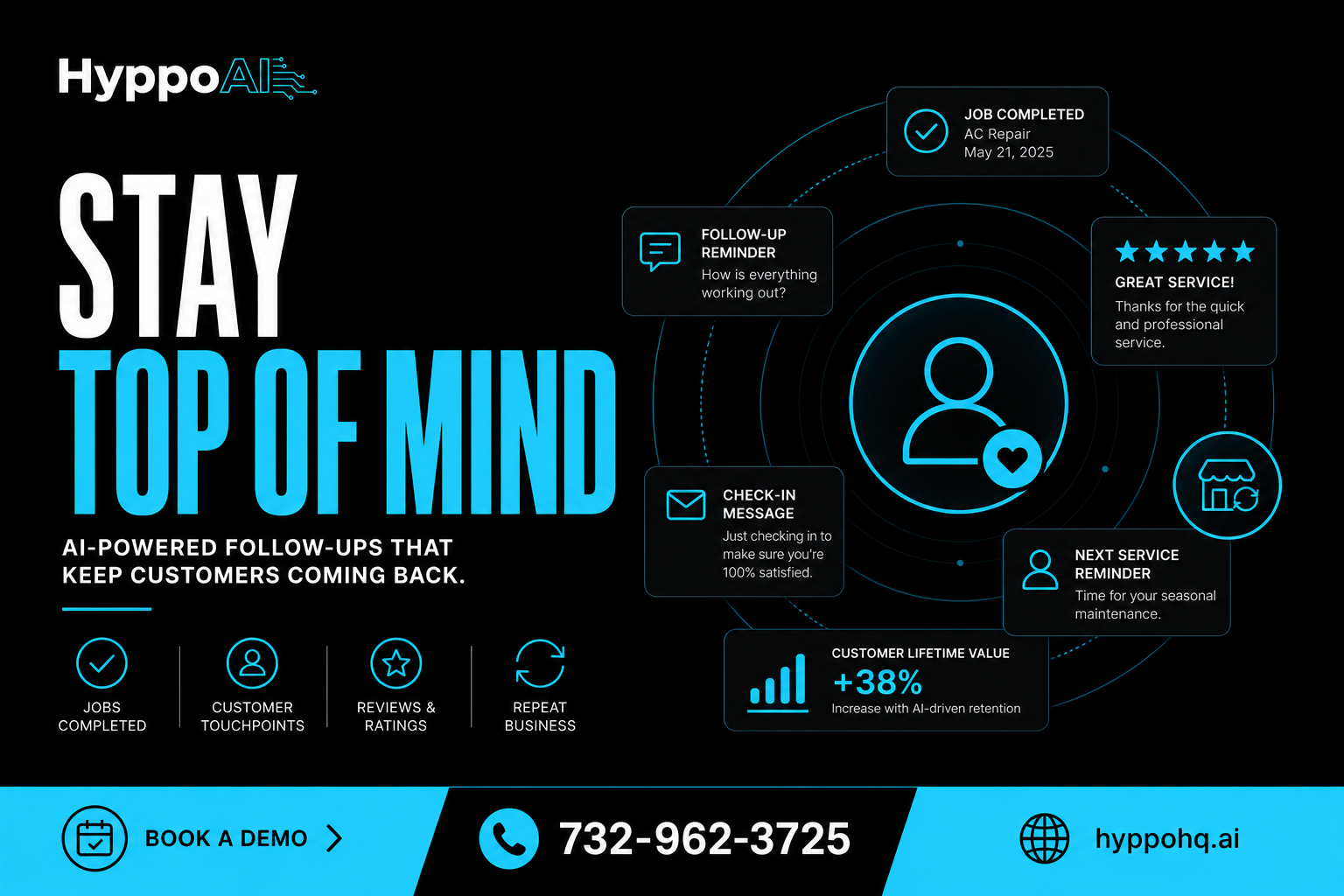
How businesses stay top-of-mind after the job is done
Most businesses put all their energy into getting the lead, closing the sale, and completing the work.
Then they go quiet.
That silence is expensive.
If you want more repeat business, more referrals, and stronger customer loyalty, you need a system that keeps your company top-of-mind after the job is done. The businesses that grow consistently are not always the loudest or the cheapest. They are the ones customers remember when the next need comes up.
For small and midsize businesses, this is where process beats guesswork. And increasingly, this is where AI can help.
Why staying top-of-mind matters
When a customer has already trusted you once, the next sale should be easier than the first. But that only happens if they remember you at the right moment.
Top-of-mind awareness matters because it drives:
- Repeat purchases
- Referrals to friends, family, and coworkers
- Better online reviews
- Higher customer lifetime value
- Lower customer acquisition costs
The problem is simple. Most business owners assume good work speaks for itself.
Good work matters. But memory fades fast.
If another company follows up better, checks in more consistently, or makes rebooking easier, they often win the next opportunity.
What makes customers remember a business
Customers usually remember businesses for a few specific reasons:
1. You followed up when others did not
A quick message after the job can make a big difference. It shows professionalism, care, and consistency.
Examples include:
- A thank-you text or email
- A satisfaction check-in
- A reminder about next steps or maintenance
- A request for feedback or a review
2. You made the next action easy
People are busy. If rebooking, asking a question, or referring someone takes effort, many customers will do nothing.
Businesses stay memorable when they reduce friction.
That can look like:
- Simple appointment reminders
- One-click review requests
- Easy reply options by text
- Clear follow-up timelines
3. You showed up consistently
Consistency builds familiarity. Familiarity builds trust.
A business that appears occasionally in a helpful, relevant way is far more likely to be remembered than one that disappears for months.
Common mistakes after the job is done
Many businesses lose momentum after delivery because they rely on manual follow-up or inconsistent habits.
Here are the most common breakdowns:
- No post-service communication
- No review request process
- No re-engagement campaign for past customers
- No system for missed calls or after-hours inquiries
- No segmentation based on customer history
- No tracking of who needs follow-up and when
These are not usually marketing problems. They are systems problems.
How to stay top-of-mind with a simple post-job system
You do not need a complicated funnel. You need a reliable sequence.
A practical post-job system can include the following stages.
Immediate follow-up
Within 24 hours of the job being completed, send a short message that:
- Thanks the customer
- Confirms the work is complete
- Invites questions or concerns
This creates confidence and gives customers a clear path back to you.
Review request
Once the customer has had a little time to experience the result, ask for a review.
Keep it direct and easy. The best review requests are:
- Short
- Timely
- Specific
- Friction-free
A strong review system does two things at once: it strengthens your reputation and keeps your brand fresh in the customer's mind.
Value-based check-in
A few weeks or months later, send a useful check-in. Not a generic sales blast. Something relevant.
Examples:
- Maintenance reminders
- Seasonal service suggestions
- Helpful tips based on the completed job
- A reminder to schedule the next visit
This works because it feels useful, not intrusive.
Re-engagement for inactive customers
Past customers are one of the most underused growth channels in small business.
If someone has not heard from you in a while, a re-engagement message can bring them back.
For example:
- “It has been a while since your last service.”
- “If you need help again, we are here.”
- “Want to get back on the schedule?”
Simple, direct, and timely beats clever.
Where AI helps SMBs do this consistently
The challenge is not knowing what to do. The challenge is doing it every time.
That is where AI and automation become practical.
For SMBs, AI can support post-job communication by helping teams:
- Trigger follow-up messages automatically
- Route customer replies quickly
- Respond after hours
- Organize customer data for better timing
- Identify missed follow-up opportunities
- Keep communication consistent without adding admin load
This is especially important for businesses that handle a high volume of calls, appointments, estimates, or repeat service cycles.
AI does not replace the relationship. It supports the process that protects the relationship.
Top-of-mind strategies that actually work
If you want a practical starting point, focus on these five:
1. Build a follow-up cadence
Create a standard timeline for what happens after every completed job.
For example:
- Day 1: Thank-you message
- Day 3 to 7: Review request
- Day 30 or later: Helpful check-in
- Future interval: Rebooking or re-engagement reminder
2. Use customer communication channels they already prefer
If your customers respond to text, use text. If they prefer email, use email. The best system is the one customers actually engage with.
3. Personalize without overcomplicating
You do not need a custom essay for every customer. Even basic personalization helps.
Use details like:
- First name
- Service type
- Date of service
- Relevant next step
4. Ask for reviews as part of the workflow
Do not leave reviews to chance. Make them part of the completion process.
This improves visibility, trust, and recall.
5. Track the handoff after service
A completed job should trigger the next communication automatically. If nothing happens after completion, the system is broken.
The long-term payoff
Businesses that stay top-of-mind do not just get remembered. They create compounding advantages.
Over time, they often see:
- More repeat revenue from existing customers
- More referrals without extra ad spend
- Better review volume and stronger trust signals
- Faster response times and fewer dropped opportunities
- More predictable growth from existing relationships
That is the real shift.
Instead of treating every new sale like a cold start, you build a business that gets chosen again because customers already know who to call.
Final thought
The job is not over when the work is done. That is when retention, reputation, and repeat business begin.
If your business wants to stay top-of-mind, start by tightening the follow-up system. Make it timely. Make it easy. Make it consistent. Then use AI where it removes delays, missed steps, and manual bottlenecks.
If you want to explore how HyppoAI helps SMBs create smarter follow-up and automation systems, visit https://hyppohq.ai or call +17329623725 to learn more.
