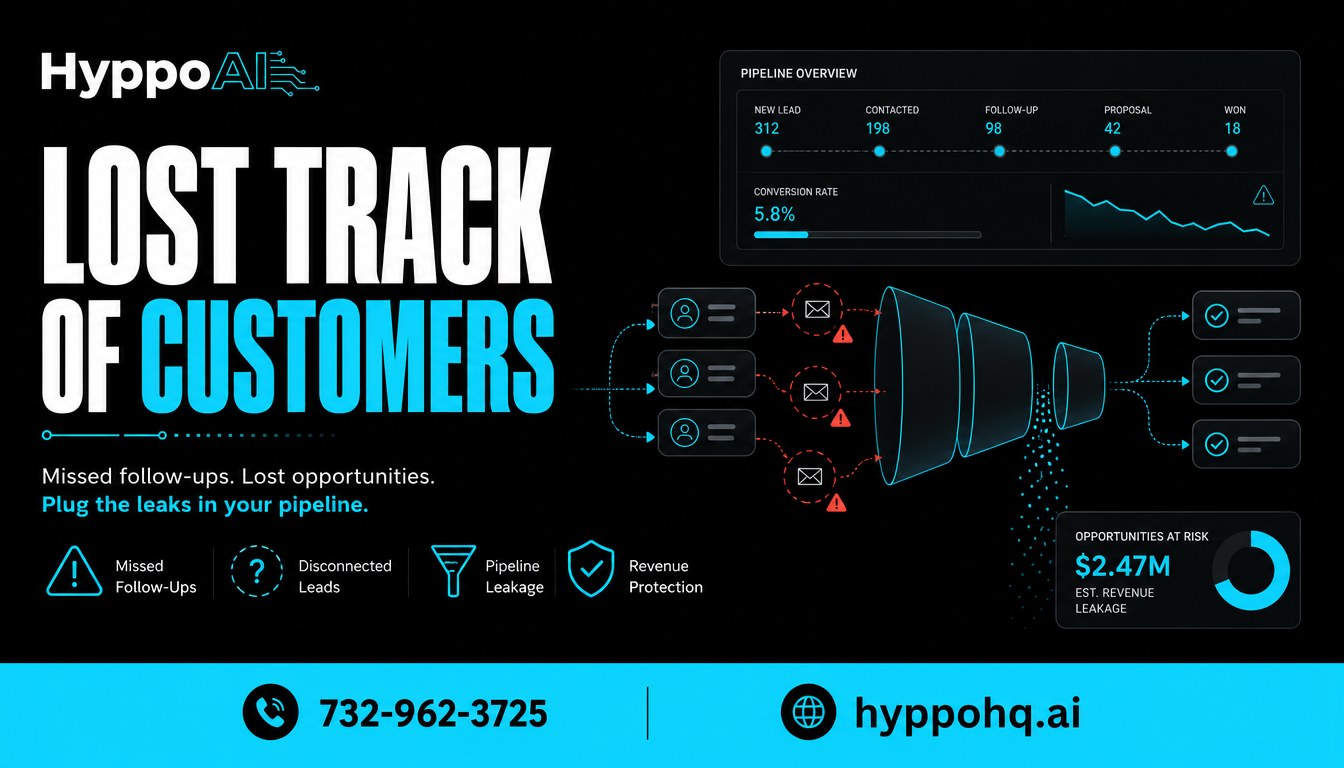
How businesses lose track of interested customers
Every business owner has felt it: a prospect reaches out, shows real interest, and then seems to vanish.
But in many cases, that customer did not lose interest overnight. The business simply lost track of them.
This happens more often than most teams realize. A missed call, a delayed text, a forgotten email, or a lead sitting in the wrong inbox can quietly turn warm interest into lost revenue. For small and mid-sized businesses, these leaks add up fast.
If your team is working hard but leads still slip through the cracks, the problem may not be demand. It may be your follow-up system.
Why interested customers get lost
Most businesses do not lose leads because their service is bad. They lose leads because their process is inconsistent.
Interested customers move quickly. They compare options, ask questions, and expect timely responses. If they do not hear back, they often move on to the next company.
Here are some of the most common reasons businesses lose track of interested customers:
- Calls come in after hours and no one responds fast enough
- Website forms go to a shared inbox that no one owns
- Social media messages are checked inconsistently
- Staff members forget to log follow-ups
- Notes live in multiple places instead of one system
- Leads are contacted once, then never nurtured again
- The business assumes silence means the prospect is not interested
None of these issues feel dramatic in the moment. But together, they create a system where good leads quietly disappear.
The hidden cost of poor follow-up
When businesses think about lost customers, they often focus on marketing first. They assume they need more traffic, more ads, or more content.
Sometimes the bigger issue is what happens after a customer raises their hand.
If 20 people contact your business this week and only a portion get a fast, organized response, your marketing is not the only thing underperforming. Your operations are too.
Poor follow-up can lead to:
- Lower conversion rates
- Wasted ad spend
- Frustrated staff
- Slower sales cycles
- Missed repeat business
- A weaker customer experience
This is especially important for SMBs, where every lead matters more. Large companies may absorb inefficiency. Smaller businesses usually cannot.
Where leads commonly fall through the cracks
The breakdown is rarely in one place. It usually happens across several touchpoints.
Missed calls
A missed call is not just a missed conversation. It is often a missed buying moment.
Many prospects call when they are ready to act. If no one answers and there is no immediate follow-up, the lead may call someone else within minutes.
Contact forms
Website forms look simple, but they fail often in practice. If notifications are unclear or follow-up ownership is undefined, leads can sit untouched for hours or days.
Texts and DMs
Customers now reach out across multiple channels. They may text, message on Facebook or Instagram, or reply to a previous conversation. If your team is not monitoring those channels consistently, interest gets lost in plain sight.
Manual handoffs
When one person takes the inquiry and another is supposed to follow up later, details can get dropped. Manual handoffs are one of the biggest causes of lead leakage.
No clear next step
Sometimes a team replies, but the response is weak. If the customer does not get a clear next step, such as booking, scheduling, or confirming, the conversation stalls.
The signs your business is losing interested customers
You may already have clues.
Watch for patterns like:
- People saying, "I never heard back"
- Long delays between inquiry and response
- Team members asking where a lead came from
- Follow-up depending on memory instead of a system
- Low booking rates despite steady inquiry volume
- Prospects going cold after the first touch
If these issues sound familiar, the answer is not to work harder manually. It is to build a better process.
How better systems keep leads from disappearing
The businesses that win more customers usually do not rely on luck. They rely on speed, visibility, and consistency.
A strong lead handling system should do a few things well:
Capture every inquiry
Every call, form, message, and text should be tracked in one place whenever possible. If inquiries live across disconnected tools, it becomes harder to respond and easier to forget.
Respond quickly
Speed matters. Even a basic acknowledgment can keep a lead engaged while your team prepares the next step.
Route leads clearly
Someone should own the next action. Ambiguity kills follow-up.
Automate repetitive tasks
Reminders, confirmations, initial replies, and lead routing do not always need to be manual. Automation can reduce delays and human error.
Create visibility
You should be able to answer simple questions at any time:
- How many leads came in?
- Which ones were contacted?
- Which ones are waiting?
- Which sources convert best?
Without visibility, leads get lost and no one knows where.
Why AI is changing lead follow-up for SMBs
For many small and mid-sized businesses, the challenge is not knowing follow-up matters. The challenge is having enough time and staff to do it consistently.
That is where AI can help.
AI tools can support faster responses, better lead routing, and more consistent communication without adding more manual work to your team. In the right setup, AI can help businesses:
- Respond to inquiries faster
- Reduce missed opportunities after hours
- Keep conversations organized
- Support staff instead of replacing them
- Create a more reliable customer journey
The goal is not complexity. The goal is fewer dropped leads and more closed opportunities.
A practical way to think about the problem
If your business is generating interest but not converting enough of it, ask this question:
What happens in the first 5 minutes after someone reaches out?
That window often determines whether a lead moves forward or disappears.
If the answer depends on who is available, who remembered to check messages, or who had time to follow up, then your business is vulnerable to losing interested customers every day.
A reliable system beats good intentions.
Final takeaway
Businesses lose track of interested customers when follow-up is slow, scattered, or inconsistent. The problem is usually not a lack of demand. It is a lack of process.
The good news is that this can be fixed. With better systems, clearer ownership, and smart automation, businesses can capture more of the opportunities they are already creating.
If your team is missing calls, juggling messages, or struggling to follow up consistently, HyppoAI helps SMBs build practical AI systems that reduce lead loss and improve response speed. Visit https://hyppohq.ai or call +17329623725 to learn more.
