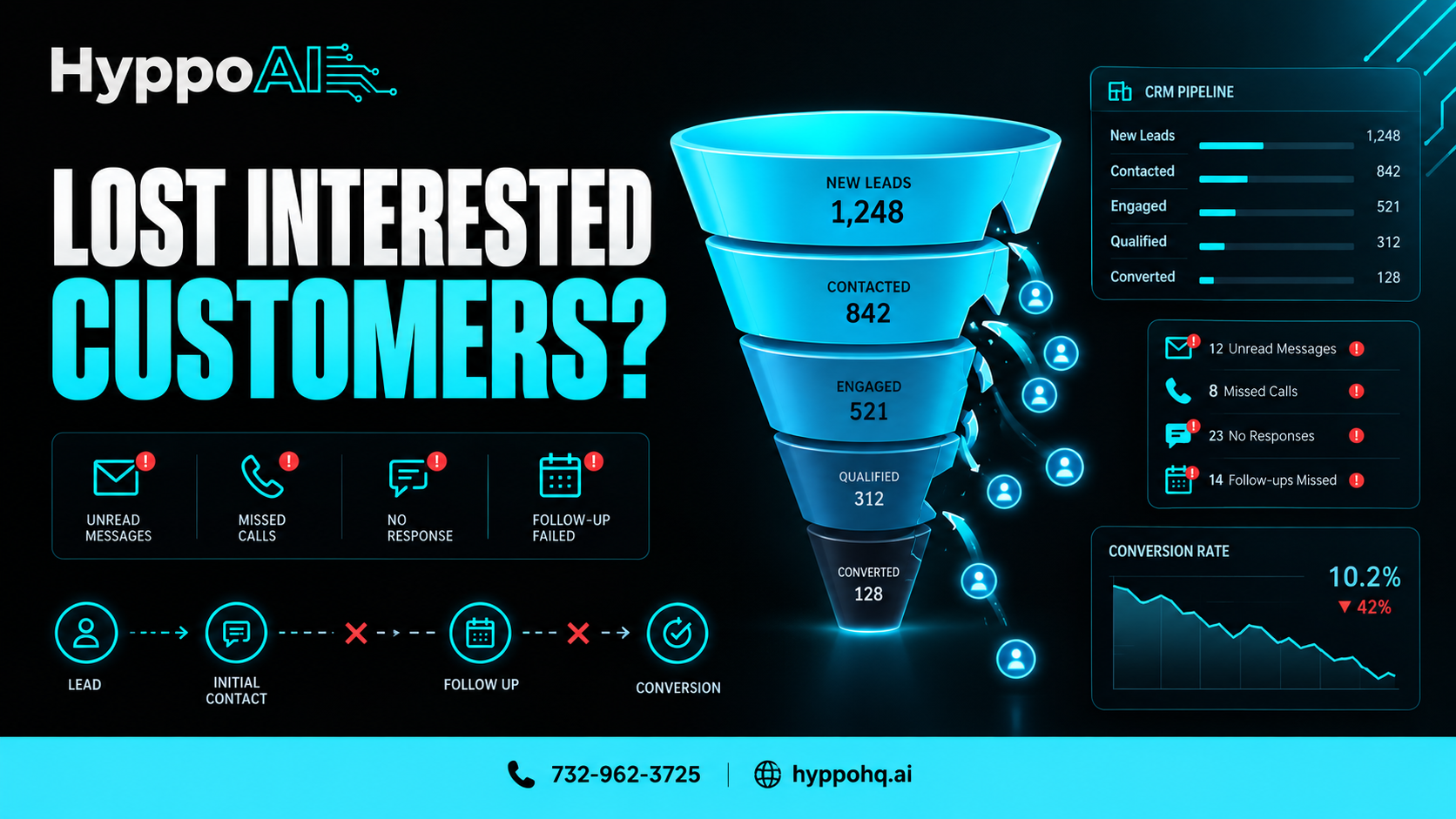
How businesses lose track of interested customers
Most businesses do not have a lead problem. They have a tracking problem.
A potential customer calls, fills out a form, sends a social media message, or replies to an email. They are interested in that moment. Then something breaks. The message gets buried, the call goes unanswered, the follow-up is delayed, or no one owns the next step.
That is how businesses lose track of interested customers.
It usually is not dramatic. It is operational. Small gaps in response time, visibility, and process quietly turn warm interest into lost revenue.
Why interested customers slip away
When someone reaches out, they are giving your business a short window of attention. If your team cannot capture, organize, and act on that signal quickly, the lead cools off.
Common reasons this happens include:
- Missed phone calls during busy hours
- Form submissions going to one inbox that no one checks consistently
- Social media DMs handled manually with no system
- No central place to track conversations
- Slow response times after initial contact
- No clear follow-up schedule
- Leads assigned informally instead of systematically
- Staff assuming someone else already handled it
None of these issues sound huge on their own. Together, they create friction at exactly the wrong time.
The hidden cost of poor lead tracking
Losing track of interested customers affects more than sales.
It also impacts:
- Marketing ROI, because paid and organic leads are wasted
- Team efficiency, because staff duplicate work or miss handoffs
- Customer experience, because prospects feel ignored
- Forecasting accuracy, because the pipeline is incomplete
- Business reputation, because inconsistent follow-up reduces trust
If you are spending time or money to generate interest, but you cannot reliably move that interest into a conversation, your growth stalls.
Where businesses usually lose the lead
The breakdown often happens in a few predictable places.
1. The first contact is not captured properly
A lead may come in through multiple channels:
- Phone calls
- Website forms
- Chat widgets
- Facebook or Instagram messages
- Email replies
- Text messages
If these channels do not feed into one system, visibility disappears fast. One team member may see the message, another may not, and no one knows whether the prospect got a response.
2. Response time is too slow
Speed matters. A prospect who is ready now will not wait long.
Even a delay of a few hours can reduce the chance of converting interest into a booked call or appointment. If the response comes the next day, the customer may already be speaking with a competitor.
3. Follow-up depends on memory
If your process relies on someone remembering to call back, send an email, or check in later, leads will fall through the cracks.
Memory is not a system.
A business needs structured follow-up with clear triggers, timelines, and ownership.
4. There is no lead status visibility
Without defined stages, every lead looks the same.
You need to know whether a prospect is:
- New
- Contacted
- Waiting for reply
- Qualified
- Booked
- Closed
- Lost
When those stages are missing, leadership cannot see where leads are getting stuck or why conversion is inconsistent.
5. Handoffs are unclear
One person answers the call. Another sends the estimate. Someone else is supposed to follow up. If those handoffs are not documented, the customer journey becomes fragmented.
The prospect experiences that fragmentation as silence.
Signs your business is losing interested customers
Many SMBs do not realize how often this is happening until they look closely.
Watch for these warning signs:
- You get inquiries, but bookings feel lower than expected
- Team members ask, "Did anyone get back to them?"
- Calls and messages are handled differently by each employee
- Lead notes are incomplete or scattered across apps
- You cannot easily report how many leads came in this week
- Follow-up happens only when someone has time
- Prospects say they never heard back
- Sales performance varies wildly with no obvious cause
These are not just communication issues. They are systems issues.
How to stop losing track of interested customers
The good news is that this problem is fixable.
You do not always need more leads. You need a better process for handling the leads you already have.
Centralize every inquiry
Start by making sure all inbound interest is visible in one place.
That could include:
- Calls logged automatically
- Forms routed into a shared system
- DMs captured and assigned
- Emails tied to contact records
- Notes stored with the lead, not in personal inboxes
The goal is simple: no inquiry should live in isolation.
Define response standards
Create a clear rule for how fast new leads should receive a response.
For example:
- Immediate acknowledgment for forms and messages
- Fast callback for missed calls
- Same-day follow-up for all new inquiries
Once the standard exists, it can be measured.
Use lead stages and ownership
Every lead should have:
- A current status
- A next action
- A person responsible
- A follow-up date
This removes ambiguity and makes accountability easier.
Automate what should not be manual
Many early-stage follow-up tasks can be automated without making the experience feel robotic.
Examples include:
- Instant confirmation messages
- Missed-call text responses
- Lead routing to the right team member
- Reminder sequences for unresponsive prospects
- Appointment scheduling prompts
Automation is not about replacing people. It is about making sure interested customers do not disappear while your team is busy.
Review the pipeline weekly
A simple weekly review can reveal where leads are getting lost.
Look at:
- Total new inquiries
- Response times
- Number of missed calls
- Conversion by lead source
- Leads with no next step
- Stalled opportunities by stage
This helps leadership move from guessing to diagnosing.
Why this matters even more for SMBs
Large businesses can sometimes absorb inefficiency. SMBs usually cannot.
When a small or mid-sized business loses track of interested customers, the impact is immediate. Every missed conversation can mean lost cash flow, underused marketing spend, and slower growth.
That is why systems matter.
For SMBs, the difference between steady growth and inconsistency often comes down to whether the business can respond, track, and follow up at scale.
AI can help close the gaps
This is where AI becomes practical, not theoretical.
AI can support businesses by helping them:
- Capture inbound interest across channels
- Respond faster to common inquiries
- Route leads based on intent or urgency
- Trigger follow-up automatically
- Surface leads that need attention
- Reduce dependence on manual admin work
The point is not to add complexity. It is to reduce the number of places a lead can get lost.
When the system is clearer, the team performs better and the customer experience improves.
Final thought
Interested customers usually do not vanish for no reason. They get lost in the gaps between contact, response, and follow-up.
If your business is generating attention but not converting enough of it, start by looking at the process. The issue may not be demand. It may be the system handling demand.
If you want to explore how AI can help your business track inquiries, improve follow-up, and reduce missed opportunities, visit https://hyppohq.ai or call +17329623725 to learn more.
