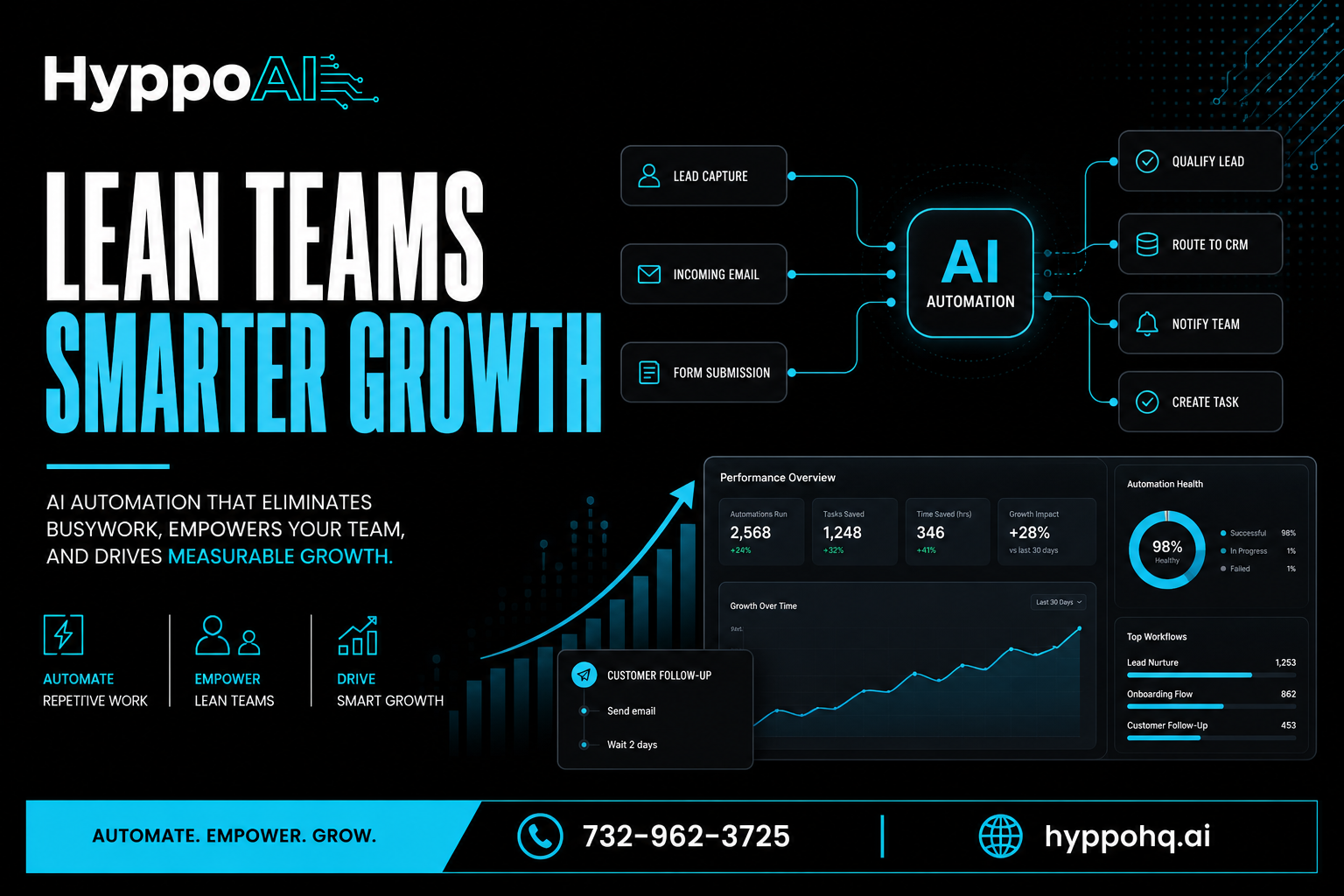
How automation supports lean teams and smarter growth
Lean teams win when they protect time, reduce friction, and stay focused on work that actually moves the business forward. That is where automation becomes practical.
For small and mid-sized businesses, automation is not about replacing people. It is about removing repetitive tasks, speeding up routine workflows, and giving lean teams the support they need to do more with less strain.
When implemented well, automation helps teams stay responsive, organized, and scalable without adding unnecessary headcount. The result is better output, fewer missed opportunities, and more room for strategic work.
Why lean teams feel pressure first
Lean teams usually operate with limited time, budget, and bandwidth. One person may handle sales follow-up, scheduling, customer communication, and internal reporting all in the same day.
That model can work for a while, but it creates predictable problems:
- Repetitive admin work eats up productive hours
- Important follow-ups get delayed or missed
- Manual processes increase the risk of errors
- Team members spend time switching between tools
- Growth creates bottlenecks faster than the team can adapt
Automation helps by taking low-leverage tasks off the team’s plate. Instead of constantly reacting, people can focus on decisions, customer relationships, and execution.
How automation supports lean teams in real operations
The biggest advantage of automation is not speed alone. It is consistency.
A lean team may be excellent at what it does, but even strong teams struggle when too many steps depend on memory, manual entry, or constant oversight. Automation creates repeatable systems that run the same way every time.
1. It reduces repetitive work
Every business has tasks that need to happen but do not require human judgment every single time.
Examples include:
- Sending appointment confirmations
- Routing inbound inquiries
- Logging customer data into a CRM
- Triggering reminders for unpaid invoices
- Following up after a form submission
- Answering common first-touch questions
When these actions are automated, team members recover hours each week. That reclaimed time can be used for sales conversations, service delivery, and problem-solving.
2. It improves response times
Lean teams often lose leads and momentum because they simply cannot reply fast enough.
Automation can support immediate engagement through:
- Instant lead acknowledgment
- Automated qualification flows
- Scheduled follow-up sequences
- AI-powered chat or voice responses
- Smart routing to the right person or department
Fast responses build trust. They also increase the chances that a prospect stays engaged long enough to convert.
3. It reduces human error
Manual workflows break down under pressure. A missed message, a typo in customer data, or a forgotten follow-up can lead to lost revenue and a poor customer experience.
Automation helps standardize routine actions so fewer things fall through the cracks. That matters even more for lean teams because there is less redundancy built into the operation.
4. It creates visibility
A lot of lean teams are working hard without a clear picture of where time is going or where leads are getting stuck.
Automation tools can help track:
- Lead sources
- Response times
- Follow-up completion rates
- Appointment volume
- Common customer questions
- Workflow bottlenecks
Better visibility leads to better decisions. Instead of guessing what needs attention, teams can improve based on real patterns.
Where automation makes the biggest impact first
Not every process should be automated on day one. The best place to start is where repetitive work, delays, or inconsistency are already causing friction.
Customer communication
This is often the fastest win.
If your team is manually replying to common inquiries, confirming appointments, or chasing follow-ups, automation can create immediate relief. AI tools and workflow systems can handle first responses, reminders, and routing without making the experience feel cold or robotic.
Lead management
Leads should not sit untouched because the team is busy.
Automation can capture inquiries, tag them, assign them, and trigger the next step instantly. That means fewer missed opportunities and a more reliable sales process.
Scheduling and reminders
Back-and-forth scheduling wastes time for both staff and customers. Automated booking flows, reminders, and rescheduling options reduce no-shows and cut down on admin overhead.
Internal handoffs
Lean teams often lose momentum during transitions between sales, support, and operations. Automated handoffs make sure information moves cleanly from one stage to the next.
That can include:
- Creating tasks automatically after a sale
- Notifying the right team member when action is needed
- Updating records after customer interactions
- Triggering onboarding sequences
What automation does not replace
Automation supports lean teams best when it handles structure, not strategy.
It is ideal for repeatable tasks, but people still matter for:
- Complex decision-making
- Relationship building
- Negotiation
- Creative problem-solving
- Escalations and exceptions
The goal is not to remove the human layer. The goal is to make sure humans are spending time where they add the most value.
How to introduce automation without creating more complexity
One common mistake is adding too many tools too quickly. That can create the same kind of chaos automation was meant to solve.
A better approach is to start simple.
Audit repetitive tasks
Look for tasks that happen frequently, follow the same pattern, and take up valuable time.
Ask:
- What are we doing manually every day?
- Where are delays happening?
- Which tasks require effort but not deep judgment?
- What gets missed when the team gets busy?
Prioritize one workflow at a time
Choose a single process with clear business value. For example:
- New lead follow-up
- Appointment reminders
- Intake form routing
- FAQ responses
Solve one problem well before expanding.
Measure the outcome
Track practical improvements such as:
- Time saved per week
- Faster response times
- Fewer missed leads
- Lower no-show rates
- Better team capacity
Good automation should be measurable. If it is not improving speed, consistency, or output, it needs adjustment.
Why AI makes automation more useful for SMBs
Traditional automation has always been valuable, but AI adds another layer of flexibility.
AI can help lean teams manage communication, summarize information, route requests intelligently, and support customer interactions in a more natural way. That makes automation more accessible for SMBs that need practical gains without building large internal systems.
For an AI company serving SMBs, the opportunity is straightforward: use automation to remove operational drag so teams can stay lean without becoming overloaded.
Smarter systems help lean teams grow
Growth does not always require a bigger team right away. Often, it requires better systems.
When automation is applied thoughtfully, lean teams gain more than efficiency. They gain capacity, consistency, and control. They can respond faster, serve customers better, and scale operations without relying on constant manual effort.
That is the real value of automation. It helps small teams operate like stronger systems.
If your business is looking for practical ways to automate repetitive work and support smarter growth, HyppoAI can help. Visit https://hyppohq.ai or call +17329623725 to explore how AI-driven automation can support your team.
