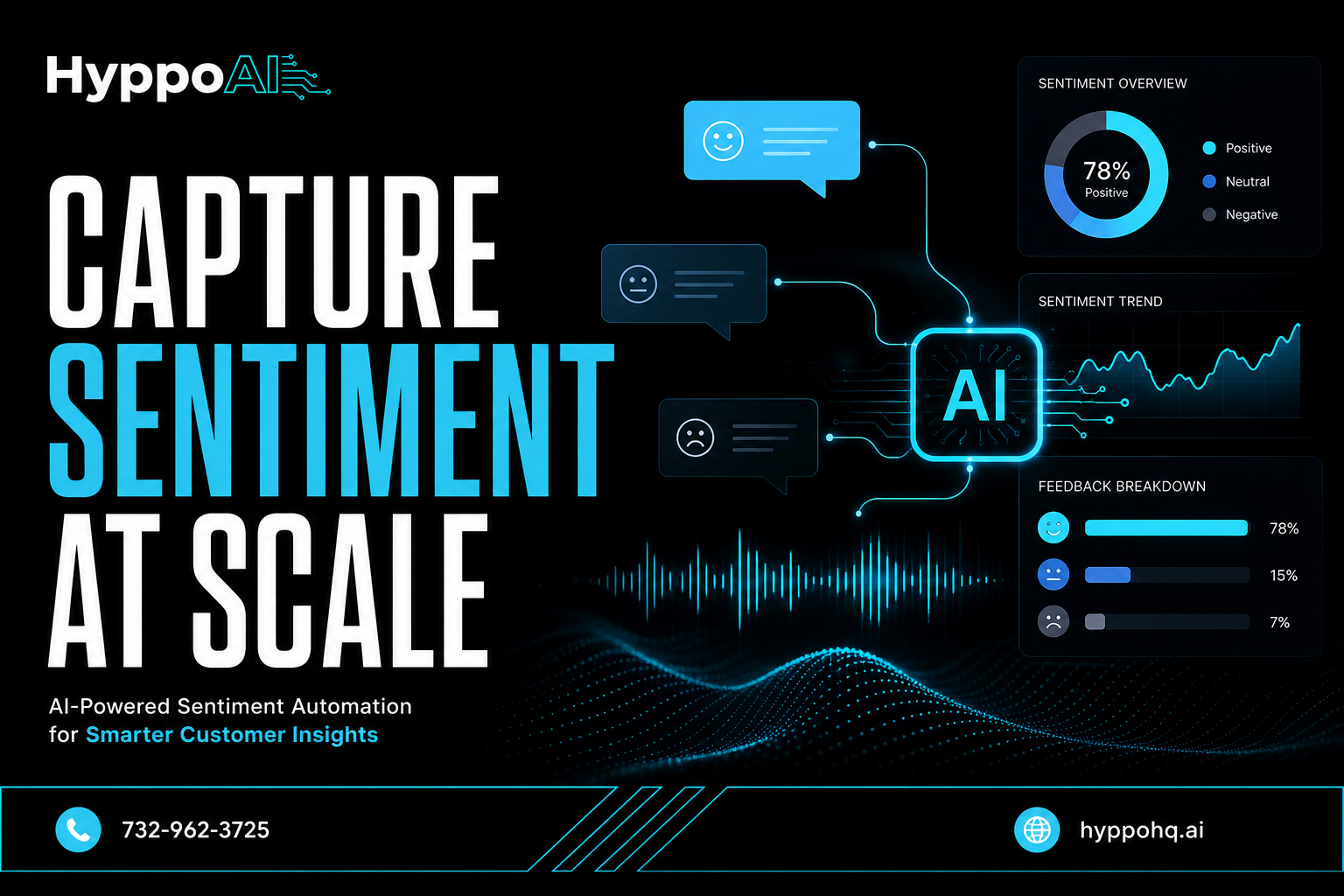
How automation helps capture customer sentiment at scale
Customer sentiment is one of the clearest signals a business can track.
It tells you how people feel about your brand, your service, your response time, and the overall customer experience. The challenge is that sentiment lives everywhere: reviews, support messages, call notes, surveys, social comments, and follow-up conversations.
For most small and mid-sized businesses, manually collecting and interpreting all of that feedback is slow, inconsistent, and easy to miss. That is where automation becomes valuable.
Automation helps capture customer sentiment by turning scattered conversations into usable insight. Instead of relying on occasional surveys or a team member's gut feeling, businesses can build systems that continuously collect feedback, organize it, and flag patterns early.
What customer sentiment actually means
Customer sentiment is more than whether someone leaves a five-star review.
It is the emotional tone behind customer interactions. That can include:
- Satisfaction after a purchase
- Frustration during onboarding
- Trust in your team
- Confusion about pricing or process
- Excitement about results
- Disappointment after a delayed response
When sentiment is positive, customers are more likely to stay, refer others, and leave strong reviews. When sentiment turns negative, retention, reputation, and conversion can suffer.
The problem is not that businesses do not care. The problem is that sentiment data is often unstructured and spread across too many channels.
Why manual sentiment tracking breaks down
A manual process usually looks familiar:
- Someone checks reviews once a week
- A manager reads a few support tickets
- Survey responses sit in a spreadsheet
- Social comments are reviewed only when there is time
- Call feedback depends on what an employee remembers
This creates blind spots.
Important feedback gets missed. Trends show up too late. Teams react to the loudest complaint instead of the most common issue. And because the process is inconsistent, leadership may not trust the data enough to act on it.
Automation solves this by making sentiment capture continuous, repeatable, and easier to analyze.
How automation helps capture customer sentiment
Automation does not replace human judgment. It improves the speed and consistency of collecting signals so your team can focus on decisions.
1. It gathers feedback from multiple channels
Customers do not all communicate in the same place.
Some leave reviews. Others reply to text messages, answer surveys, send emails, or mention concerns during calls. Automation can pull these signals into one workflow so feedback is not trapped in separate tools.
This matters because a business rarely gets the full picture from one source alone.
For example, reviews may show broad satisfaction, while support conversations reveal recurring frustration around scheduling, billing, or follow-up.
2. It captures feedback in real time
Timing matters.
If you only review sentiment once a month, you are often looking at old problems. Automation helps trigger feedback collection right after key moments, such as:
- A completed service
- A support interaction
- A missed call follow-up
- A delivery or onboarding milestone
- A renewal or cancellation event
That gives businesses fresher, more accurate sentiment data and a better chance to respond before a small issue becomes churn or a public complaint.
3. It standardizes the collection process
One of the biggest benefits of automation is consistency.
Instead of relying on employees to remember when and how to ask for feedback, businesses can create repeatable workflows. Every customer can receive the same survey prompt, follow-up request, or check-in at the right stage of the journey.
This reduces bias and makes the data more useful over time.
When collection is standardized, it becomes easier to compare sentiment across locations, services, teams, or time periods.
4. It organizes unstructured feedback
A major obstacle in sentiment tracking is that customer language is messy.
People do not always say, "I am dissatisfied." They say things like:
- "No one got back to me."
- "The service was great, but it took too long."
- "I had to call twice."
- "Your team fixed it fast."
Automation can help sort this feedback into themes and identify emotional signals at scale. Instead of reading every message one by one, teams can quickly see common patterns tied to speed, communication, professionalism, pricing, or outcomes.
5. It flags issues earlier
One negative comment is not always a trend.
But if multiple customers mention the same issue over a short period, that is something leadership needs to know fast. Automated systems can surface repeated complaints, sudden sentiment drops, or changes in review patterns before they damage reputation or revenue.
Early visibility helps teams move from reactive to proactive.
Where SMBs benefit most from automated sentiment capture
For SMBs, automation is especially useful because teams are lean and time is limited.
You may not have a dedicated analyst or customer insights department. But you still need visibility into what customers are experiencing.
Common use cases include:
Post-service feedback
After a job, appointment, or completed project, automation can request feedback while the experience is still fresh.
Review monitoring
Businesses can track review trends and identify whether negative sentiment is tied to a specific issue such as delays, missed expectations, or communication gaps.
Support and follow-up analysis
Messages from support inboxes, texts, and call summaries often reveal friction that surveys miss.
Lead handling and first response experience
Customer sentiment starts before the sale. If leads experience slow replies or missed calls, that frustration affects conversions and trust.
What to look for in an automated sentiment workflow
Not every automation setup needs to be complex.
For many SMBs, the most effective system starts with a few fundamentals:
- Feedback collection at key customer touchpoints
- Centralized storage for responses and conversation data
- Basic tagging by topic or stage in the customer journey
- Alerts for negative feedback or repeated complaints
- Reporting that shows trends over time
The goal is not to collect more data for the sake of it. The goal is to make feedback actionable.
Best practices for using automation well
Automation works best when paired with clear business processes.
Here are a few practical guidelines:
Keep requests simple
Short feedback prompts usually get better response rates than long surveys.
Trigger feedback at the right time
Ask too early and customers may not have enough context. Ask too late and the response quality drops.
Combine quantitative and qualitative input
Ratings are useful, but comments explain why customers feel the way they do.
Route urgent issues to a human
Automation should identify problems quickly, but human follow-up is still critical when a customer is unhappy.
Review trends, not just isolated comments
Look for repeated themes across multiple interactions. That is where the operational insights usually are.
The bigger value: better decisions
When businesses capture customer sentiment consistently, they make better decisions.
They can improve service workflows, strengthen follow-up, coach teams, reduce churn risk, and protect their reputation. They can also identify what customers value most and double down on it.
That is the real advantage of automation.
It does not just save time. It gives SMBs a clearer, more reliable view of the customer experience, which leads to smarter action.
If your business wants a more scalable way to collect and use customer feedback, HyppoAI helps SMBs build practical AI and automation systems that support better operations and better customer insight. Visit https://hyppohq.ai or call +17329623725 to learn more.
