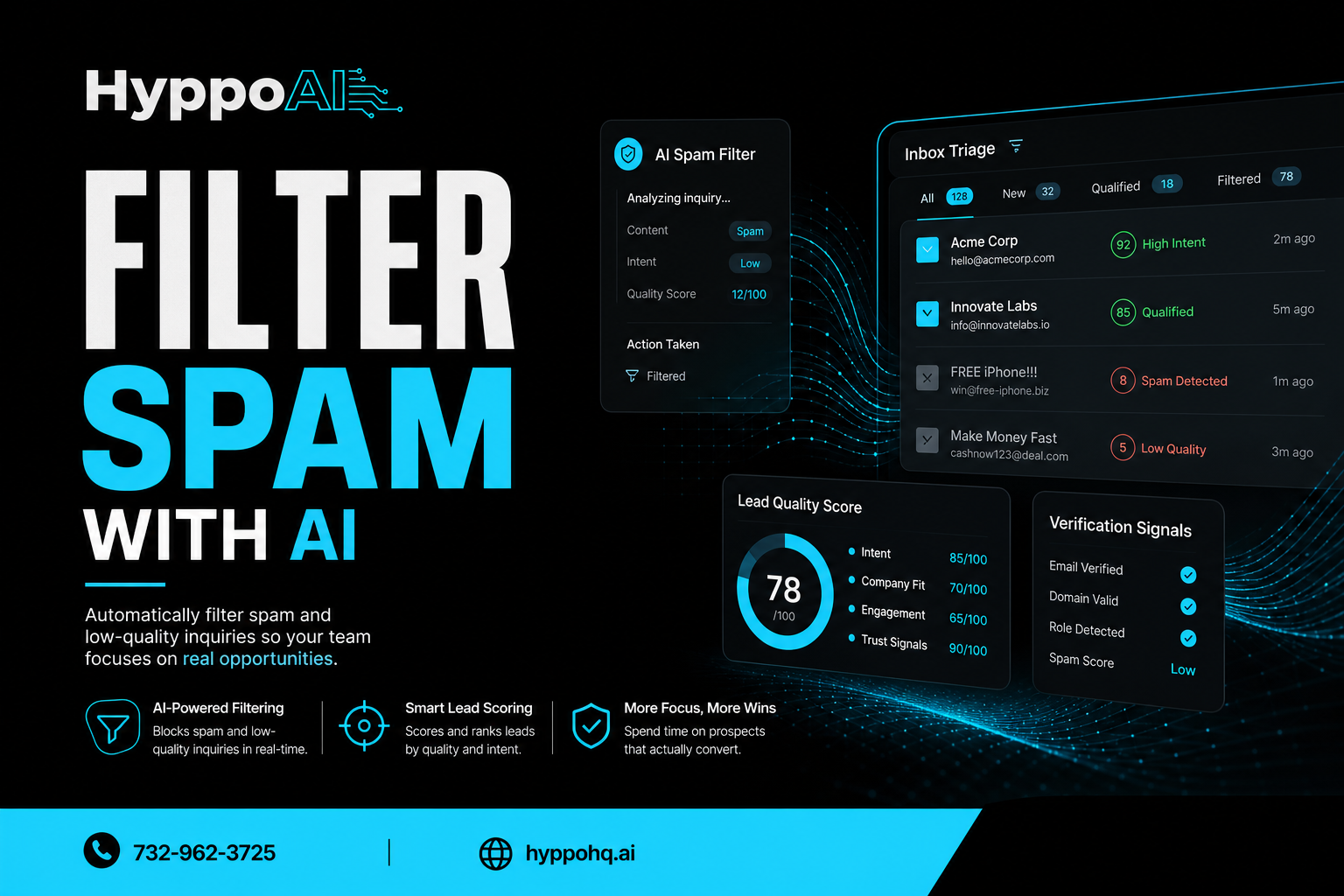
How AI helps filter spam and low-quality inquiries
Every growing business runs into the same problem: not every inquiry deserves the same attention.
Some messages are obvious spam. Others look real at first, but turn out to be irrelevant, incomplete, or unlikely to convert. When your team has to sort through all of that manually, valuable time gets wasted and strong leads can slip through the cracks.
That is where AI can make a real difference.
Instead of treating every form fill, chat message, email, or inbound request the same, AI can help businesses identify spam, flag low-quality inquiries, and route legitimate opportunities faster. For SMBs, that means less noise, better response times, and more focus on the conversations that actually matter.
Why spam and low-quality inquiries are such a problem
Most businesses do not just lose time to spam. They also lose momentum.
When your inbox, contact forms, or lead channels are filled with junk, your staff has to spend energy reviewing messages that go nowhere. That creates a few common issues:
- Slower response times for real prospects
- More manual admin work
- Higher chance of missing qualified leads
- Frustration for sales and support teams
- Less reliable reporting on lead quality
Low-quality inquiries are not always malicious. Sometimes they come from people outside your service area, students doing research, vendors pitching unrelated services, or users submitting incomplete information. They may not be spam in the traditional sense, but they still distract your team from revenue-generating work.
How AI helps filter spam
AI filtering works by analyzing patterns in incoming messages and comparing them against signals that often indicate spam or poor fit.
Depending on the system, AI can review:
- Message content and wording
- Repetitive phrases or suspicious formatting
- Email address quality and domain patterns
- Phone number validity
- Form completion behavior
- IP or geographic mismatch
- Frequency of repeated submissions
Pattern recognition at scale
Traditional filters often rely on static rules. For example, they may block certain keywords or reject duplicate submissions. That can help, but it is limited.
AI improves on that by spotting combinations of signals instead of just one rule at a time. A message might not contain a classic spam phrase, but it may still look suspicious based on structure, intent, and behavior. AI can score that inquiry accordingly.
This matters because spam evolves. Static filters can quickly become outdated, while AI models can adapt to changing patterns more effectively.
Natural language understanding
One of the biggest advantages of AI is its ability to interpret language more intelligently.
A basic filter may only catch obvious junk. AI can go further by identifying whether a message is:
- Relevant to your business
- Specific enough to act on
- Likely sent by a real prospect
- Aligned with your services or target market
For example, if your company serves SMBs in a specific niche, AI can help detect whether an inquiry actually matches that profile. If not, it can tag the message as low priority or route it differently.
How AI identifies low-quality inquiries
Not every weak lead should be deleted. Some just need different handling.
That is why AI is useful not only for blocking spam, but also for classifying inquiry quality.
Lead scoring based on fit
AI can assign a quality score to inbound inquiries based on criteria such as:
- Completeness of the submission
- Clear buying intent
- Service relevance
- Budget or urgency indicators
- Location fit
- Past interaction history
A vague message like "need help call me" may not deserve the same priority as a detailed inquiry describing a real business need. AI can help surface that difference instantly.
Smart routing and tagging
Once AI evaluates an inquiry, it can trigger the next step automatically.
Examples include:
- Sending high-quality leads directly to sales
- Routing support-related questions to the right team
- Marking likely spam for review or archive
- Tagging low-fit inquiries for lower-priority follow-up
- Requesting more information before a human gets involved
This helps teams spend less time sorting and more time responding.
Benefits for SMBs
Large enterprises have long invested in lead qualification systems, but SMBs often rely on manual processes longer than they should. That creates bottlenecks.
AI makes filtering and qualification more accessible without requiring a massive team.
Better use of team time
When staff no longer have to manually review every weak inquiry, they can focus on:
- Real customer conversations
- Faster follow-up
- Better service delivery
- Higher-value sales activity
Faster response to real leads
Speed matters. If a qualified lead waits too long because your team is buried in junk submissions, you may lose that opportunity.
AI helps reduce that delay by pushing strong inquiries to the front of the line.
Cleaner data and reporting
If spam and poor-fit inquiries are mixed into your pipeline, your reporting becomes less useful. AI can improve visibility by separating noise from meaningful demand.
That leads to better decisions around marketing, staffing, and operations.
What AI filtering should not do
AI should support your team, not replace judgment completely.
A good system should avoid being overly aggressive. If filters are too strict, you risk hiding legitimate opportunities. That is why the best approach usually includes:
- Confidence scoring instead of automatic deletion
- Human review for edge cases
- Clear routing rules
- Ongoing tuning based on results
The goal is not to block everything unusual. The goal is to reduce obvious noise and make prioritization easier.
Practical use cases
AI filtering can help across multiple channels, including:
Website contact forms
AI can review submissions in real time, score quality, and flag suspicious or incomplete entries before they hit your team.
Chat and messaging
If your business uses live chat or AI chat tools, filtering can detect irrelevant or low-intent conversations and keep your pipeline cleaner.
Email inquiries
AI can sort inbound messages by intent, relevance, and urgency, helping teams focus on the right threads first.
Lead intake workflows
Businesses with high inquiry volume can use AI to enrich, tag, and route leads automatically based on fit.
How to get started
If you want to use AI to filter spam and low-quality inquiries, start simple.
Focus on three things:
- Define what a qualified inquiry looks like for your business.
- Identify the common types of spam or poor-fit messages you receive.
- Build a workflow that scores, tags, and routes inquiries based on those patterns.
You do not need a perfect system on day one. Even a basic AI-assisted process can reduce manual work and improve response quality.
For SMBs, that can be a major operational advantage.
Final thought
AI is not just about generating content or answering questions. It can also protect your team’s time.
By filtering spam, identifying low-quality inquiries, and helping prioritize real opportunities, AI gives businesses a cleaner pipeline and a more efficient way to grow.
If your team is spending too much time sorting through bad leads and irrelevant messages, HyppoAI can help you build smarter workflows. Visit https://hyppohq.ai or call +17329623725 to learn more.
