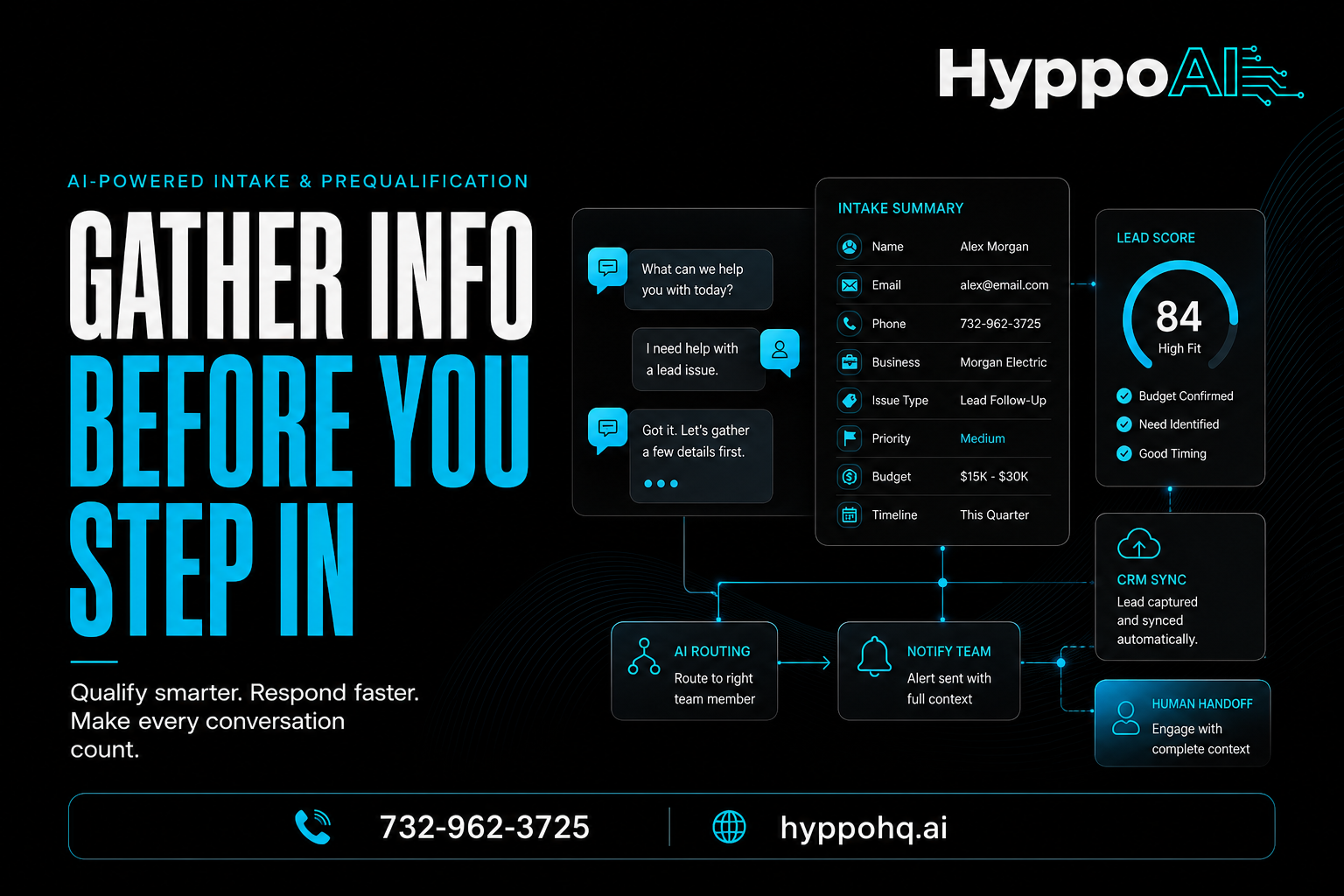
How AI can gather information before you step in
For small and mid-sized businesses, time is usually the bottleneck.
Your team is answering calls, replying to inquiries, sorting requests, and trying to figure out who needs help right now. A lot of that work happens before the real work even starts.
That is where AI becomes useful.
AI can gather information before you step in, so your team starts with context instead of starting from zero. Instead of asking the same basic questions over and over, you can have the answers ready before a person takes over.
What it means for AI to gather information first
In practical terms, this means AI handles the early part of an interaction.
That could include:
- Answering an incoming call
- Responding to a website inquiry
- Handling a chat conversation
- Following up after a missed call
- Collecting intake details from a lead or customer
The goal is simple: get the key information upfront so the next step is faster and more accurate.
For example, AI can ask questions like:
- What service are you looking for?
- Is this urgent?
- What is your name and best contact number?
- What day works best for you?
- Are you an existing customer or a new lead?
By the time a human joins the conversation, the basics are already covered.
Why this matters for SMBs
Most SMBs do not have unlimited staff.
When every call, message, or form submission requires manual back-and-forth, your team loses time on repetitive tasks. That creates slower response times, inconsistent follow-up, and missed opportunities.
AI helps reduce that friction.
Instead of replacing your team, it supports your team by handling the first layer of information gathering.
The biggest benefits
Here are a few of the immediate advantages:
- Faster response times
- Better lead qualification
- Fewer missed details
- More consistent intake
- Less administrative work for staff
- Better customer experience
If someone reaches out after hours, AI can still engage them. If your front desk is busy, AI can still collect the essentials. If your sales team wants cleaner lead data, AI can help standardize what gets captured.
AI does not need to do everything
A common mistake is thinking AI has to fully solve the entire customer interaction.
It does not.
Often, the highest-value use case is much simpler: let AI gather the right information, then route the conversation to the right person.
That approach works because it respects both speed and accuracy.
AI is good at:
- Asking structured questions
- Capturing repeatable data points
- Following a consistent process
- Operating instantly at any hour
Humans are still better at:
- Complex decision-making
- Handling nuance and emotion
- Solving unusual cases
- Closing high-trust conversations
The best systems use both.
Common use cases for pre-qualification and intake
Different businesses use AI in different ways, but the pattern is similar. AI handles the first step so the human handles the most important step.
Lead qualification
If someone is interested in your services, AI can ask a few key questions before a salesperson gets involved.
That might include:
- Service type
- Budget range
- Timeline
- Location
- Project scope
This helps your team prioritize serious opportunities and respond with more context.
Customer support triage
Not every support request needs the same level of attention.
AI can gather details about the issue, identify urgency, and organize requests before they reach your staff. That makes response workflows cleaner and faster.
Appointment and booking intake
Before scheduling, AI can collect the information needed to make the appointment useful.
Examples include:
- Reason for the appointment
- Preferred time window
- Contact details
- Existing customer status
- Special notes
This reduces back-and-forth and helps your team show up prepared.
Missed call follow-up
Missed calls are lost opportunities if nobody responds quickly.
AI can immediately follow up, ask what the caller needed, and capture enough information for your team to continue the conversation with context.
What good AI information gathering looks like
Not all automation is helpful.
If the experience feels robotic, confusing, or too long, people drop off. The process has to be simple and logical.
A strong AI information-gathering workflow should be:
- Clear: questions are easy to understand
- Short: only ask for what matters
- Relevant: tailor questions to the request
- Fast: get to the point quickly
- Actionable: pass useful information to the team
The point is not to create more steps.
The point is to remove unnecessary steps for your staff while making it easier for customers and leads to move forward.
How to decide what AI should collect
Start by looking at the questions your team repeats every day.
Those repeated questions are usually the best place to begin.
Ask yourself:
- What information do we always need first?
- What slows down our team during intake?
- What details are often missing?
- Which requests should be prioritized or routed differently?
Once you identify those patterns, you can design an AI workflow around them.
A simple framework
Use this basic structure:
- Identify the trigger point
- Define the must-have questions
- Keep the conversation short
- Route the information to the right person
- Review and improve the flow over time
For many SMBs, even a small improvement at the intake stage creates a meaningful operational gain.
The real value is context
The biggest benefit is not just automation.
It is context.
When a team member steps into a conversation already knowing the customer’s need, urgency, and basic details, the interaction is smoother for everyone.
That means:
- Less repetition for the customer
- Better preparedness for your staff
- Faster decisions
- More efficient handoffs
- A more professional experience overall
People do not want to repeat themselves. Teams do not want to chase missing information. AI helps close that gap.
Where businesses get stuck
Some businesses delay using AI because they assume implementation has to be complicated.
It does not have to start big.
You can begin with one high-friction area, such as:
- New lead intake
- Missed call response
- Website chat qualification
- Appointment request collection
Start with one workflow. Measure the time saved. Improve the questions. Expand from there.
That is usually the smartest path.
AI first, human next
The best way to think about this is simple: AI first, human next.
Let AI handle the predictable opening steps. Let your team handle the parts that require judgment, trust, and expertise.
That combination gives SMBs a practical advantage.
You are not asking your team to do less important work. You are helping them spend less time on repetitive intake and more time on the work that actually moves the business forward.
If you want to see how AI can gather information before your team steps in, HyppoAI can help you build smarter workflows for intake, follow-up, and customer interactions. Visit https://hyppohq.ai or call +17329623725 to learn more.
