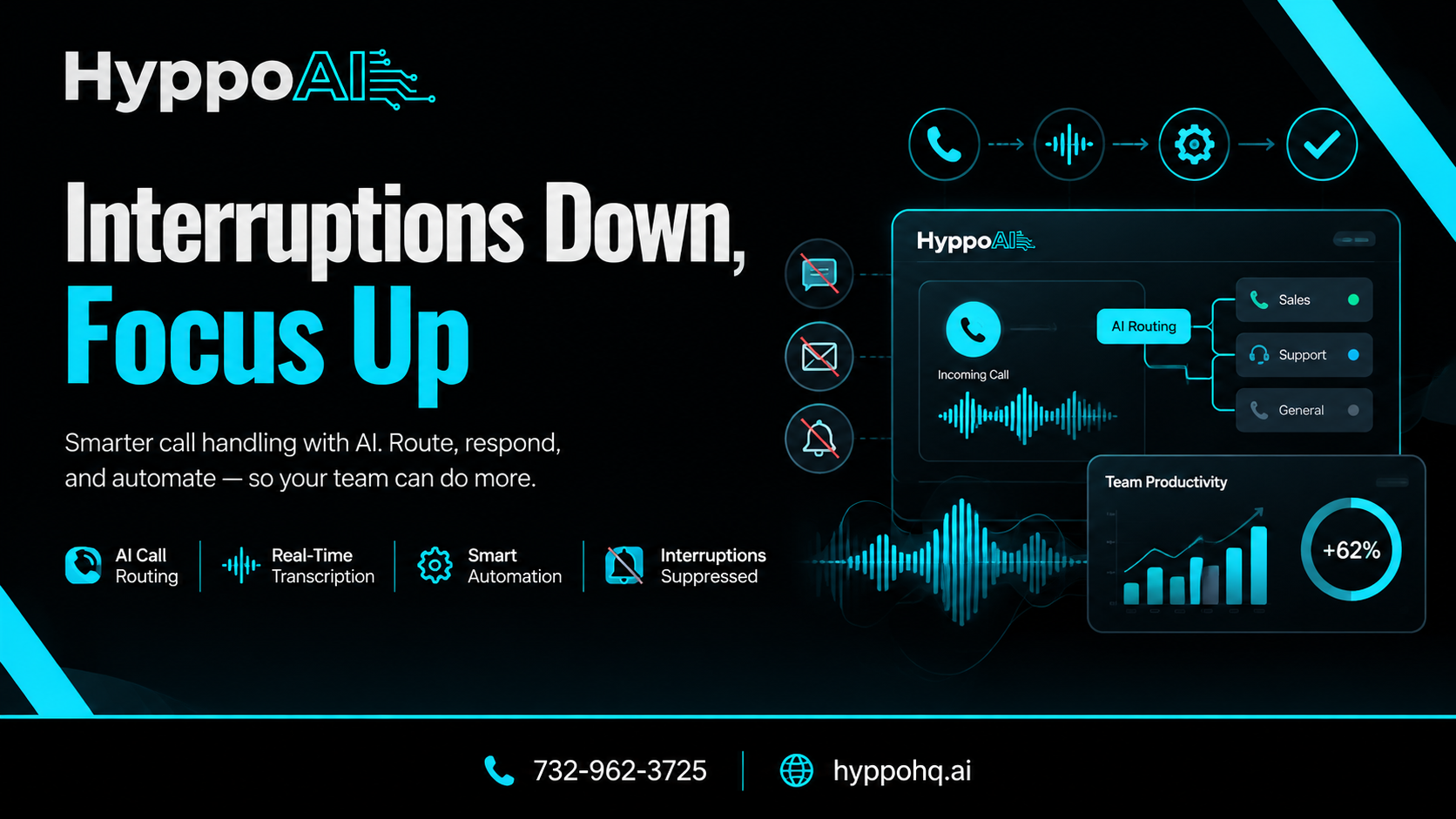
How AI call handling reduces interruptions during the day
Phone calls are important, but constant interruptions can quietly drain a business day.
For many small and midsize businesses, every ringing phone creates a decision point: stop what you are doing and answer, let it ring and risk losing a lead, or interrupt someone else on the team. Over time, that pattern creates friction, fragmented attention, and slower execution.
AI call handling offers a practical way to reduce those interruptions without sacrificing responsiveness. Instead of forcing your team to react to every incoming call in real time, AI can answer, qualify, route, and document conversations automatically.
The result is simple: fewer disruptions, better focus, and a more consistent caller experience.
Why phone interruptions hurt productivity
Most business owners underestimate how expensive interruptions really are. It is not just the minute spent answering a call. It is also the time it takes to switch context, pause a task, handle the conversation, and then get back into focused work.
When this happens repeatedly throughout the day, it can affect:
- Deep work and concentration
- Response times on priority projects
- Team efficiency and morale
- Scheduling and follow-through
- Overall customer experience
For service-based SMBs, the challenge is even bigger. Calls often come in during customer visits, meetings, estimates, admin work, or after-hours periods. That means the business is constantly balancing availability with operational focus.
What AI call handling actually does
AI call handling uses voice automation to answer inbound calls and guide the conversation based on your business needs. It is not just a digital voicemail box. A well-configured AI system can actively manage common call flows in real time.
Common tasks AI call handling can manage
Depending on setup, AI can:
- Answer calls instantly
- Greet callers professionally and consistently
- Collect names, contact details, and reason for calling
- Qualify leads with preset questions
- Route urgent calls to the right person
- Take messages accurately
- Help with appointment requests
- Handle after-hours inquiries
- Log call details for follow-up
This means your team does not need to stop what they are doing for every routine call. Instead, they can step in only when a conversation truly needs human attention.
How AI call handling reduces interruptions during the day
The biggest advantage of AI call handling is not just answering the phone. It is filtering noise from true priorities.
1. It screens routine calls automatically
A large share of daily calls are repetitive. People ask about hours, availability, service areas, pricing basics, next steps, or whether someone can call them back.
Without AI, each of those calls pulls someone away from active work. With AI call handling, those conversations can be managed automatically, which reduces unnecessary interruptions while still helping the caller.
2. It protects focused work time
Every business has tasks that require uninterrupted attention: quoting, planning, dispatching, bookkeeping, hiring, customer service, and sales follow-up.
AI call handling creates a buffer around that work. Instead of reacting to every ring, your team can work in blocks and review qualified calls or messages at the right time.
That shift can improve both output and decision-making.
3. It routes only high-priority calls
Not every call deserves immediate escalation. Some do.
AI can identify urgency based on caller intent and route those calls appropriately. For example, a high-value new lead or a time-sensitive service issue can be passed through quickly, while lower-priority inquiries can be documented for later response.
This helps your team stay accessible without being constantly interrupted.
4. It reduces missed calls without adding pressure
Many interruptions happen because teams feel they must answer immediately or risk losing business. That pressure creates a reactive work environment.
AI changes that dynamic. Calls can be answered right away, even when your team is busy, unavailable, or off the clock. Callers get a response, and your business captures the information needed to continue the conversation later.
That means fewer missed opportunities and less day-to-day stress.
5. It creates cleaner follow-up workflows
Interruptions are not always caused by the call itself. Sometimes the bigger issue is the messy follow-up that comes after it.
When details are incomplete, handwritten, or passed along verbally, your team spends more time clarifying what happened. AI call handling can capture and organize call information in a consistent format, making it easier to respond efficiently.
Better information leads to fewer internal interruptions later.
Where SMBs see the biggest impact
AI call handling is especially useful for businesses that depend on inbound calls but cannot afford constant disruption.
Common fit for AI call handling
- Home service companies
- Local service businesses
- Busy front-desk operations
- Small sales teams
- Owner-led businesses
- Companies with after-hours call volume
In these environments, the phone is both a revenue channel and a source of constant context switching. AI helps separate the two.
What better call handling looks like in practice
A more effective phone workflow does not mean removing people from the customer experience. It means using people where they add the most value.
A practical setup often looks like this:
- AI answers every inbound call
- Routine questions are handled automatically
- Lead details are captured consistently
- Urgent or high-intent calls are routed live
- Non-urgent calls become organized follow-up tasks
- Your team reviews and responds on schedule instead of in panic mode
This approach keeps the business responsive while protecting time for execution.
Key benefits beyond fewer interruptions
Reducing interruptions is the immediate win, but it is not the only one.
Additional advantages of AI call handling
- Faster answer times
- More consistent caller experience
- Better lead capture
- Improved team focus
- Less manual message-taking
- Stronger after-hours coverage
- More scalable operations
For growing SMBs, these gains matter. They support better service without requiring the business to stay in constant reaction mode.
What to consider before implementing AI call handling
Not all solutions are equal, and results depend on how well the system matches your workflow.
Before adopting AI call handling, think about:
- Which calls are repetitive versus high-value
- What information should always be collected
- When a caller should be routed to a human
- How follow-up should be assigned internally
- What after-hours experience should sound like
The goal is not to automate everything. The goal is to reduce unnecessary interruptions while keeping important conversations moving.
Final thought
If your team is losing momentum because the phone keeps breaking the day into fragments, AI call handling is worth serious attention. It helps your business stay available without forcing everyone into constant interruption.
For SMBs, that can mean a better customer experience, stronger lead capture, and more productive workdays.
If you want to explore how HyppoAI can help your business reduce interruptions with AI call handling, visit https://hyppohq.ai or call +17329623725.
