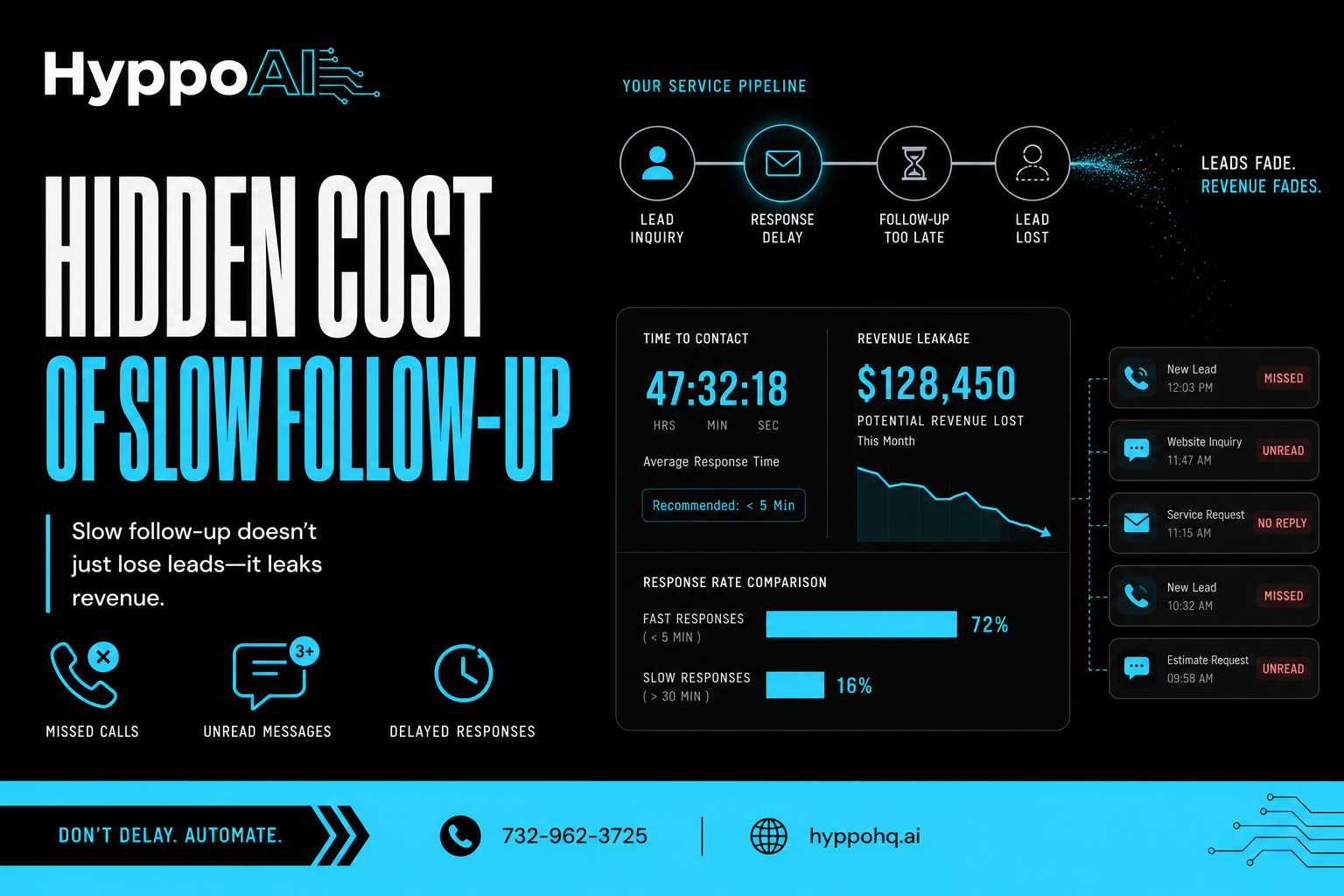
Hidden cost of slow follow-up in service businesses
In service businesses, speed is not just a customer service metric. It is a revenue metric.
Every missed call, delayed text, or unanswered form submission creates friction between interest and action. And in that gap, leads cool off, competitors step in, and opportunities disappear.
The problem is that slow follow-up often looks harmless from the inside. A team gets busy. Calls stack up. Someone plans to respond later. On paper, nothing seems broken. But behind the scenes, the business is paying a hidden cost.
Why slow follow-up is more expensive than it looks
Most service businesses track obvious costs like ad spend, payroll, and software. Fewer track the cost of response delay.
When a prospect reaches out, they are usually in decision mode. They have a problem now. They want clarity now. And if they do not hear back quickly, they rarely wait patiently.
Instead, they:
- Call the next company
- Fill out another form
- Lose confidence in your reliability
- Decide to postpone the job entirely
That means slow follow-up does not just reduce convenience. It reduces conversion.
The hidden costs that add up fast
Lost revenue from warm leads going cold
A lead is most valuable right after they reach out. That is the moment when intent is highest.
If your business takes hours or days to respond, that warm lead starts to cool. By the time someone follows up, the prospect may have already booked elsewhere or stopped caring.
This creates a painful pattern: you keep paying to generate leads, but your process leaks value before sales even starts.
Higher customer acquisition cost
If your follow-up is slow, every lead becomes more expensive.
Why? Because you already paid to earn attention through referrals, ads, SEO, social media, or local visibility. When those leads do not convert due to delayed response, your acquisition cost rises without improving results.
In simple terms, slow follow-up makes your marketing less efficient.
Lower trust before the first conversation
Prospects make fast judgments.
If a company is hard to reach at the beginning, many people assume the actual service experience will be the same. Delayed replies can signal disorganization, poor communication, or lack of urgency.
That trust gap starts before your team ever gets a chance to explain pricing, process, or quality.
Missed calls that never come back
Many service businesses underestimate how final a missed call can be.
A missed inbound call is not always a second-chance opportunity. In many cases, it is the only chance. If no one answers and no immediate follow-up happens, that lead often moves on.
This is especially true in high-intent categories where people need help quickly and are contacting multiple providers.
Operational drag on your team
Slow follow-up also creates internal inefficiency.
When messages pile up, your team spends more time:
- Sorting old inquiries
- Trying to reconnect with unresponsive leads
- Managing voicemail and inbox clutter
- Switching between tasks to catch up
That reactive workflow drains focus. Instead of handling fresh demand in real time, the team is constantly recovering from delays.
Why service businesses are especially vulnerable
Service businesses operate in a high-speed, high-trust environment.
Whether someone needs a quote, consultation, appointment, or urgent help, the expectation is clear: respond quickly and make the next step easy.
The challenge is that many small and midsize businesses do not have front-desk coverage around the clock. Calls come in after hours. Staff members are in the field. Office teams juggle multiple responsibilities. Follow-up becomes inconsistent, even when the business is doing good work.
That is where hidden cost turns into a scaling problem.
If demand increases but response systems do not improve, growth creates more missed opportunities, not more closed business.
What slow follow-up looks like in practice
Sometimes the issue is obvious. Sometimes it hides in normal operations.
Common signs include:
- Calls going to voicemail during busy periods
- Web form submissions sitting unanswered for hours
- Text messages receiving delayed replies
- No after-hours response process
- Leads falling through between office staff and field staff
- No clear ownership of inbound inquiries
If any of these sound familiar, the business likely has more revenue sitting in the pipeline than it realizes.
The real competitive advantage is response time
A lot of service businesses focus on price, branding, or ad strategy. Those matter. But response speed is often the simpler lever with the faster payoff.
When two companies offer similar services, the one that responds first usually has the advantage.
Fast follow-up helps you:
- Reach leads while intent is still high
- Book more appointments
- Build trust earlier
- Reduce lead waste
- Improve return on existing marketing
It is not always about generating more leads. Sometimes the biggest win comes from handling current leads better.
How AI can reduce follow-up delays
This is where AI becomes practical, not theoretical.
For SMB service businesses, AI can help close the response gap by handling repetitive front-end communication quickly and consistently.
Depending on the workflow, AI can support:
- Instant responses to inbound inquiries
- Call answering when staff is unavailable
- Lead qualification and routing
- Appointment scheduling support
- After-hours engagement
- Follow-up consistency across channels
The goal is not to replace human service. The goal is to make sure real opportunities do not sit untouched while your team is busy doing the work.
A smarter way to think about follow-up
Instead of asking, "How many leads did we get?" ask:
- How fast did we respond?
- How many calls were missed?
- How many inquiries got a same-day reply?
- How many leads dropped off before a real conversation?
These questions reveal where revenue is being lost.
In many cases, the business does not have a lead generation problem. It has a lead handling problem.
That is good news, because process problems can be fixed.
What to improve first
If you want to reduce the hidden cost of slow follow-up, start with the basics:
1. Audit your current response time
Measure how long it takes to reply to calls, forms, and texts during business hours and after hours.
2. Identify where leads get stuck
Look for handoff points, missed calls, and inboxes with unclear ownership.
3. Create a consistent first response
Make sure every inquiry gets a fast, helpful acknowledgment and a clear next step.
4. Cover gaps outside normal hours
Leads do not only arrive when your team is available. Your system should account for that.
5. Use automation where speed matters most
If your team cannot respond instantly every time, technology should help bridge the gap.
Final thought
Slow follow-up is expensive because it hides in plain sight. It does not show up as a line item, but it affects revenue, trust, efficiency, and growth.
For service businesses, faster response is not a nice-to-have. It is part of the sales process.
If your business is investing in lead generation but still seeing inconsistent conversion, the issue may not be demand. It may be what happens in the minutes after someone reaches out.
If you want to explore how AI can help your business respond faster and capture more opportunities, visit https://hyppohq.ai or call +17329623725.
