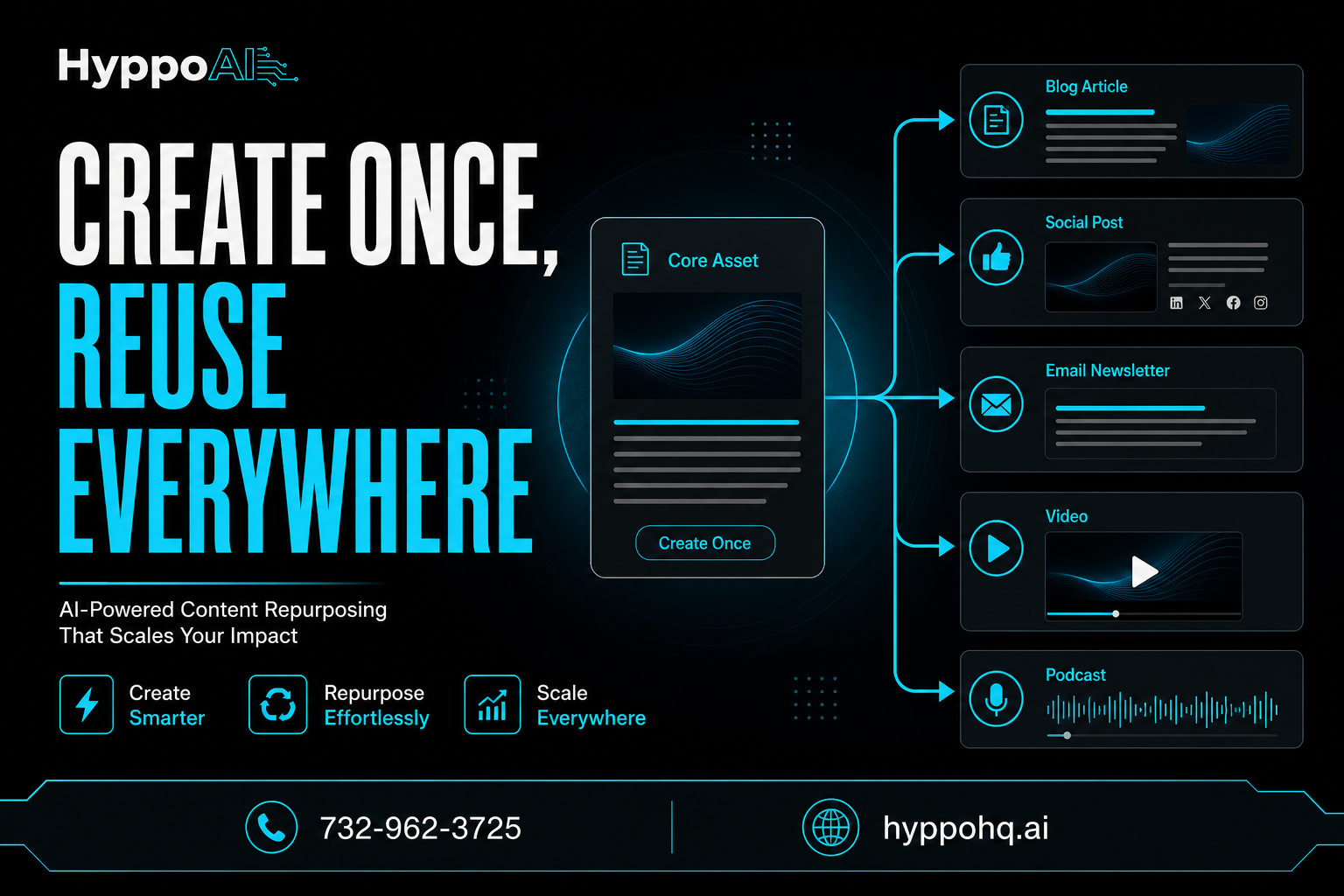
Content repurposing: create once, reuse everywhere
When content is created once and reused well, it stops being a one-time task and starts acting like a system.
That shift matters for small and midsize businesses. Instead of constantly chasing the next post, email, or video, you build one strong asset and turn it into multiple pieces that work across platforms. The result is usually more reach, better consistency, lower production pressure, and a clearer message.
For SMBs, this is not just a marketing shortcut. It is an operational advantage.
What content reuse actually means
Content reuse, often called content repurposing, means taking one original idea and adapting it into different formats for different channels.
For example, one strong piece of content can become:
- A blog post
- Several social media captions
- A short video script
- An email newsletter
- A sales follow-up message
- A FAQ answer
- A podcast talking point
- A website update
The key word is adapt. Reuse does not mean copying and pasting the exact same message everywhere without context. It means keeping the core idea while adjusting the format, tone, and length to fit the platform.
What happens when you create content once and reuse it
You save time without lowering output
Most businesses spend too much time starting from zero.
Every new post feels like a brand-new assignment. That slows momentum and creates a constant production bottleneck. When you create one solid core asset first, the rest gets easier.
Instead of making ten separate pieces from scratch, you make one and derive the other nine from it.
That can reduce:
- Writing time
- Editing time
- Approval cycles
- Creative fatigue
- Last-minute posting stress
This is one of the biggest practical benefits. Reuse turns content into a repeatable workflow instead of a recurring scramble.
Your message becomes more consistent
Repetition is not a weakness in marketing. Randomness is.
When businesses create disconnected content every day, the message often drifts. One post says one thing, the next says something slightly different, and the audience never gets a clear impression of what the company stands for.
Reusing content from a central source helps lock in consistent messaging. Your value proposition, tone, offers, and expertise show up more clearly because they are being reinforced across channels.
That consistency helps people remember you.
You reach more people in more places
Not everyone reads blogs. Not everyone watches videos. Not everyone opens emails.
If one useful idea stays in only one format, only part of your audience will ever see it. Repurposing increases the number of touchpoints without requiring a new idea every time.
A single insight can reach:
- Search traffic through a blog post
- Social audiences through short posts
- Leads through email
- Prospects through sales collateral
- Existing customers through support content
The idea stays the same, but the delivery changes. That is how reach expands efficiently.
Your content gets more mileage
Most content is underused.
Businesses often publish something once, then move on immediately. But if the topic is useful, relevant, and aligned with customer questions, there is no reason it should only work for a day.
When content is reused, its lifespan increases. A blog can fuel a month of social posts. A webinar can become clips, quotes, and follow-up emails. A customer question can become a knowledge base article and a sales enablement asset.
Good content should not expire after one use.
Why this matters for SMBs
Large teams can afford waste. SMBs usually cannot.
Smaller businesses need marketing systems that create leverage. That means getting stronger output from the same time, budget, and people.
Content repurposing supports that by helping teams:
- Do more with limited resources
- Stay visible without constant reinvention
- Build a repeatable content engine
- Support sales and marketing at the same time
- Reduce dependence on last-minute ideas
This is especially useful when a business has expertise but not endless bandwidth. If your team already has knowledge worth sharing, the real opportunity is packaging it once and reusing it intelligently.
What content reuse looks like in practice
Here is a simple example.
Say your business creates one article about a common customer problem. That one piece can become:
From one blog post
- 5 to 10 LinkedIn or Facebook posts
- 3 email newsletter angles
- 1 short-form video outline
- 3 sales talking points
- 1 FAQ page update
- 1 internal training note
Now the original work supports marketing, sales, and operations.
That is where reuse becomes powerful. It is not just about posting more. It is about extracting more business value from every good idea.
The SEO benefit of repurposed content
Content repurposing can also strengthen SEO when done correctly.
A detailed original article can become the foundation for related supporting content that reinforces the main topic. This helps build topical relevance and keeps your messaging aligned around terms your audience is already searching for.
Repurposing can support SEO by:
- Expanding coverage of related questions
- Improving internal linking opportunities
- Keeping older topics fresh through updates
- Driving traffic from multiple channels back to core pages
The important part is to avoid publishing duplicate pages with no unique value. Each reused version should serve a different purpose or audience.
Common mistakes to avoid
Not all content reuse is effective. Some businesses hear the idea and then apply it too literally.
Here are the most common mistakes:
Copying without adapting
A blog paragraph pasted directly into every platform usually underperforms. Different channels need different structure, pacing, and formatting.
Reusing weak source material
If the original content is unclear, generic, or off-message, repurposing it just spreads the problem faster.
Ignoring audience intent
A social post should not read like a white paper. An email should not feel like a transcript. Match the format to how people consume content on that channel.
Having no system
Repurposing works best when it is built into the workflow from the start. If you wait until after publishing to think about reuse, you will miss opportunities.
How to make content reuse work better
If you want strong results, start with process.
Build around pillar content
Create one substantial piece first, such as:
- A blog post
- A video
- A webinar
- A case study
- A customer Q&A
Then break it into smaller assets.
Create with reuse in mind
As you draft the original piece, identify:
- Quote-worthy lines
- Clear subtopics
- Questions people ask often
- Strong examples or frameworks
- Actionable takeaways
These become the building blocks for later formats.
Standardize your workflow
Use a simple system for turning one asset into many. For example:
- Create the core content
- Extract key points
- Rewrite for each platform
- Schedule distribution
- Track what performs best
That structure reduces friction and makes output more predictable.
The bigger business impact
When content is created once and reused, marketing becomes less reactive.
Instead of constantly asking, “What should we post today?” the better question becomes, “How many ways can this idea keep working?”
That is a smarter operating model.
It improves efficiency, reinforces brand clarity, and gives every strong idea a better chance to perform. For SMBs, that can mean less wasted effort and more consistent visibility without increasing complexity.
In simple terms: you stop treating content like a disposable task and start treating it like an asset.
If your business wants to build a smarter content workflow with AI and automation, HyppoAI can help. Visit https://hyppohq.ai or call +17329623725 to learn how to turn one strong idea into scalable output across your business.
