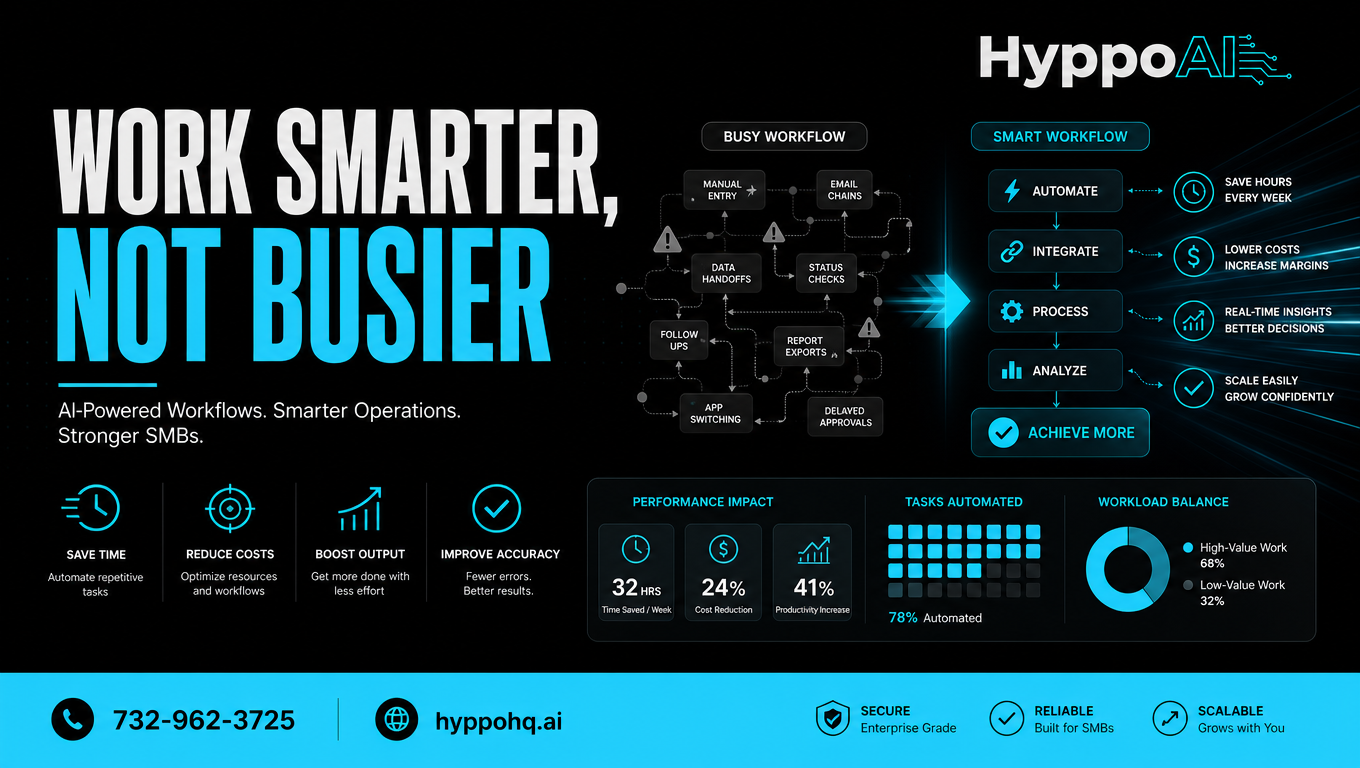
Busy vs efficient: How SMBs win more with less effort
Most business owners wear being busy like a badge of honor. Calendars are packed, inboxes are full, and the day disappears fast.
But busy does not always mean productive.
Efficiency is different. It is about getting the right work done with less friction, less waste, and better outcomes. For small and midsize businesses, that difference matters. When your team is stretched thin, every hour and every process has to count.
Being busy feels good, but it can hide problems
Busy work often creates the illusion of progress. You answer messages, sit in meetings, update spreadsheets, and jump between tasks all day. At the end of it, you feel exhausted, so it must have been a productive day, right?
Not necessarily.
A business can stay busy while still:
- Missing follow-ups
- Delaying key decisions
- Repeating manual tasks
- Losing leads after hours
- Spending too much time on low-value work
The issue is not effort. The issue is whether that effort creates meaningful results.
Signs your business is busy, not efficient
If any of these sound familiar, your operation may be running on activity instead of outcomes:
- Team members are constantly reacting instead of planning
- Important tasks depend on one person remembering them
- Customers wait too long for responses
- Work gets duplicated across tools or departments
- Reporting takes hours every week
- Everyone feels overloaded, but growth still feels slow
Busy businesses often confuse motion with momentum.
Efficiency is about outcomes, not appearances
An efficient business does not just work harder. It designs better systems.
Efficiency means:
- The right tasks happen at the right time
- Repetitive work is automated where possible
- People focus on decisions and service, not admin overload
- Customers get faster, more consistent experiences
- Leaders can see what is working and what is not
This does not mean your team sits around doing less. It means they spend more time on work that actually matters.
Efficient teams protect their attention
One of the biggest differences between busy and efficient teams is focus.
Busy teams switch contexts all day. They bounce from calls to emails to internal chat to customer issues without a clear system. That creates delays, mistakes, and mental fatigue.
Efficient teams reduce noise. They use systems, workflows, and automation to handle routine tasks so people can stay focused on higher-value work.
That is where AI can make a real difference for SMBs.
Why SMBs struggle with efficiency
Large companies can afford extra layers of staff and slower processes. SMBs usually cannot.
In a smaller business, inefficiency shows up fast:
- Missed calls become missed revenue
- Slow response times hurt trust
- Manual scheduling creates bottlenecks
- Admin work eats into sales and service time
Many owners solve this by pushing harder. They work longer hours, ask staff to do more, and keep adding tasks to the day.
That may keep the business moving for a while, but it is not a scalable strategy.
The real cost of staying busy
When your business stays trapped in busy mode, the cost is bigger than time alone.
You may also be losing:
- Lead conversion opportunities
- Customer satisfaction
- Team morale
- Decision-making clarity
- Capacity for growth
Efficiency creates room. Room to serve better, sell better, and scale without chaos.
How to shift from busy to efficient
The good news is that efficiency is not about changing everything overnight. It starts by identifying where time and attention are being wasted.
Here are practical ways to make the shift.
1. Audit repetitive tasks
Look for tasks your team repeats every day or every week.
Examples include:
- Answering the same questions
- Booking appointments manually
- Routing inquiries
- Sending reminders
- Logging call notes
- Following up with leads
If a task is repetitive and rules-based, it is a strong candidate for automation.
2. Measure outcomes, not effort
Do not judge performance by how full someone’s day looks.
Instead, ask:
- Did leads get contacted quickly?
- Did customers get answers fast?
- Were appointments booked accurately?
- Did the process move the customer forward?
Efficiency improves when you focus on results instead of visible busyness.
3. Reduce tool and process friction
A lot of wasted time comes from bad handoffs and disconnected systems.
If your team has to copy information between platforms, search for updates, or chase missing details, you have an efficiency problem.
Simpler workflows usually outperform more complicated ones.
4. Use AI where speed and consistency matter
AI is not just about novelty. For SMBs, it can remove bottlenecks in the exact places where being busy hurts most.
For example, AI can help with:
- Handling first-response conversations
- Capturing and qualifying leads
- Answering common customer questions
- Managing after-hours inquiries
- Supporting follow-up workflows
- Reducing manual admin tasks
Used correctly, AI helps your team stop spending time on predictable work and start focusing on work that requires judgment and relationships.
Busy vs efficient in customer experience
Customers do not care how busy your team is. They care how easy it is to work with your business.
If someone calls, messages, or submits a form, they expect a timely response. If they do not get one, they move on.
This is where efficient businesses stand out.
What customers notice
Customers feel the difference when your business is efficient:
- Calls get answered or routed properly
- Questions get clear responses quickly
- Appointments are booked without back-and-forth
- Follow-up happens consistently
- Communication feels organized and reliable
That experience builds trust.
A busy business often blames delays on being overwhelmed. An efficient business builds systems that prevent those delays in the first place.
Efficiency gives owners better control
For business owners, efficiency is not just about saving time. It is about gaining visibility and control.
When operations are efficient, you can:
- See where leads are coming from
- Know where follow-up is breaking down
- Understand team capacity
- Make faster, better decisions
- Grow without adding unnecessary complexity
That is a major advantage for SMBs trying to compete in fast-moving markets.
The mindset shift that matters most
The biggest shift is simple:
Stop asking, “How can we get more done?”
Start asking, “How can we get the right things done with less friction?”
That question changes how you hire, how you build workflows, and how you use technology.
It also helps you stop rewarding chaos.
Final thought
Being busy is easy to normalize. Efficiency takes intention.
If your business is always moving but not moving forward fast enough, it may be time to rethink the systems behind the work. The right AI tools and automations can help your team respond faster, reduce manual effort, and create a smoother path to growth.
If you want to explore smarter systems for your SMB, visit https://hyppohq.ai or call +17329623725 to learn how HyppoAI can help.
