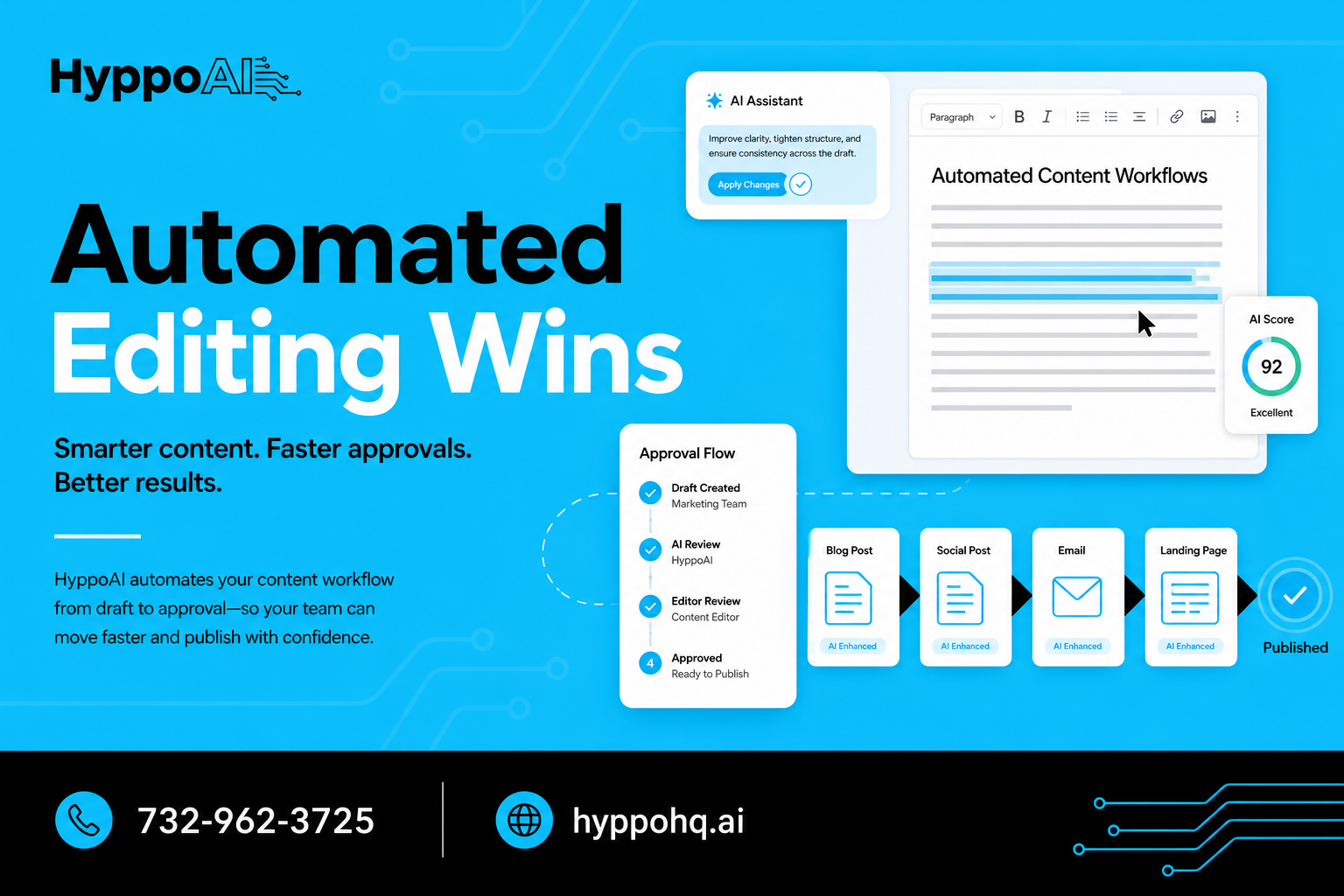
Automated editing reduces content bottlenecks for SMB teams
Content bottlenecks rarely start with bad ideas. More often, they come from slow reviews, inconsistent edits, and too many manual steps between draft and publish.
For small and mid-sized businesses, that delay adds up fast. Marketing teams wait on approvals. Sales teams wait on updated collateral. Leadership wants more output, but the process cannot keep pace.
That is where automated editing can make a real difference.
Automated editing reduces content bottlenecks by speeding up quality control, standardizing revisions, and helping teams move from draft to publish with less friction. It does not replace strategy or human judgment. It removes repetitive editing work so people can focus on clarity, positioning, and results.
What content bottlenecks actually look like
A bottleneck happens when content gets stuck at one stage of production. In most SMB workflows, editing is one of the biggest slow points.
Common examples include:
- Drafts sitting in review for days
- Multiple reviewers making conflicting edits
- Writers rewriting the same sections repeatedly
- Inconsistent tone across blogs, emails, and social posts
- Grammar, formatting, and compliance issues caught late
- Publishing delays caused by manual cleanup
These issues are not just annoying. They reduce output, create internal frustration, and make it harder to maintain a reliable content calendar.
When every piece needs heavy manual review, content stops being scalable.
Why editing becomes the choke point
Most teams think content creation is the hard part. In reality, editing often consumes more time than writing.
That happens because editing touches several layers at once:
- Grammar and readability
- Brand voice and tone
- Structure and formatting
- Accuracy and consistency
- SEO basics like headings, keyword use, and meta elements
Without a defined system, each reviewer handles these checks differently. One person focuses on style. Another rewrites for tone. Another changes formatting. The result is a long feedback loop that slows production and creates more work.
Automated editing helps by applying repeatable rules instantly.
How automated editing reduces content bottlenecks
Automated editing tools can review content in seconds and flag issues before a human editor ever opens the file. That alone can remove a major amount of back-and-forth.
1. It catches common issues early
Instead of waiting for a final review to spot basic problems, automated editing identifies them upfront.
This can include:
- Spelling and grammar errors
- Repetitive phrasing
- Passive voice overuse
- Sentence length problems
- Formatting inconsistencies
- Missing headings or unclear structure
By cleaning up first-pass issues automatically, teams reduce the number of revisions needed later.
2. It improves consistency across content
Consistency is one of the hardest things for growing teams to maintain. Different writers often produce very different outputs.
Automated editing can help enforce standards around:
- Brand tone
- Preferred terminology
- Reading level
- Style rules
- Formatting patterns
That means fewer corrections from managers and less time spent aligning content after the fact.
3. It shortens review cycles
When content arrives cleaner, reviewers can focus on higher-value decisions instead of fixing commas and sentence flow.
That changes the role of editing from line-by-line cleanup to strategic refinement.
Shorter review cycles lead to:
- Faster approvals
- More content published on schedule
- Less reviewer fatigue
- Better collaboration between writers and stakeholders
4. It supports higher output without adding headcount
SMBs often need to do more with lean teams. Automated editing makes that possible by increasing throughput.
A small team can manage more blog posts, email campaigns, landing pages, and social content when repetitive editing tasks are handled systematically.
This is especially useful when content demand increases but budgets stay tight.
The operational benefits for SMBs
For an SMB, content bottlenecks are not just a marketing problem. They affect operations, growth, and customer experience.
When editing slows everything down, businesses may struggle to:
- Launch campaigns on time
- Update service pages quickly
- Respond to market changes
- Keep sales materials current
- Maintain a strong online presence
Automated editing creates operational leverage. It helps teams build a more dependable content engine instead of relying on heroic effort.
That matters because consistency wins over time. A business that can publish useful, polished content regularly has an advantage over one that posts inconsistently due to internal delays.
What automated editing does not replace
It is important to be clear: automated editing is not the same as automated strategy.
It does not replace:
- Original ideas
- Audience insight
- Subject matter expertise
- Strong positioning
- Final human judgment
The best use of automated editing is as a workflow accelerator. It handles the repeatable parts of editing so your team can spend more time on message quality and business impact.
Think of it as a system for reducing avoidable friction.
Best practices for using automated editing well
To get the most value, businesses should treat automated editing as part of a larger content process.
Set clear editorial standards
Document what good content looks like for your business.
Include guidelines for:
- Tone of voice
- Audience reading level
- Formatting rules
- Common phrases to avoid
- SEO structure expectations
The clearer your standards, the more useful automation becomes.
Use automation before human review
Run content through automated editing before it reaches managers or final approvers.
This keeps human review focused on strategic improvements rather than surface-level corrections.
Measure where delays happen
Look at your workflow and identify where content gets stuck most often.
Track metrics like:
- Time from draft to approval
- Number of revision rounds
- Publishing delays
- Output per writer or campaign
This helps you see whether automated editing is reducing the bottlenecks that matter most.
Keep a human in the loop
Automation should support decision-making, not remove it.
A human editor or manager should still review for nuance, accuracy, and business alignment.
That balance gives you both speed and control.
Signs your business needs automated editing
If your team is experiencing any of the following, automated editing is worth serious consideration:
- Content deadlines are regularly missed
- Editors spend too much time on basic cleanup
- Writers receive inconsistent feedback
- Output is limited by review capacity
- Brand voice varies across channels
- Content production feels harder to scale than it should
These are all signs that the process needs structure, not just more effort.
The bigger picture: speed with quality
The real benefit of automated editing is not just faster turnaround. It is faster turnaround without sacrificing quality.
That is what makes it valuable for SMBs. You do not need a massive editorial department to produce polished, effective content. You need better systems.
When automated editing reduces content bottlenecks, teams gain:
- More predictable workflows
- Better consistency
- Faster publishing
- Stronger use of internal resources
- More room to focus on strategy and growth
For businesses trying to scale content without creating chaos, that is a meaningful advantage.
If your team is looking for smarter ways to streamline content operations and use AI more effectively, HyppoAI can help. Visit https://hyppohq.ai or call +17329623725 to learn how AI-driven systems can reduce friction and support scalable growth.
