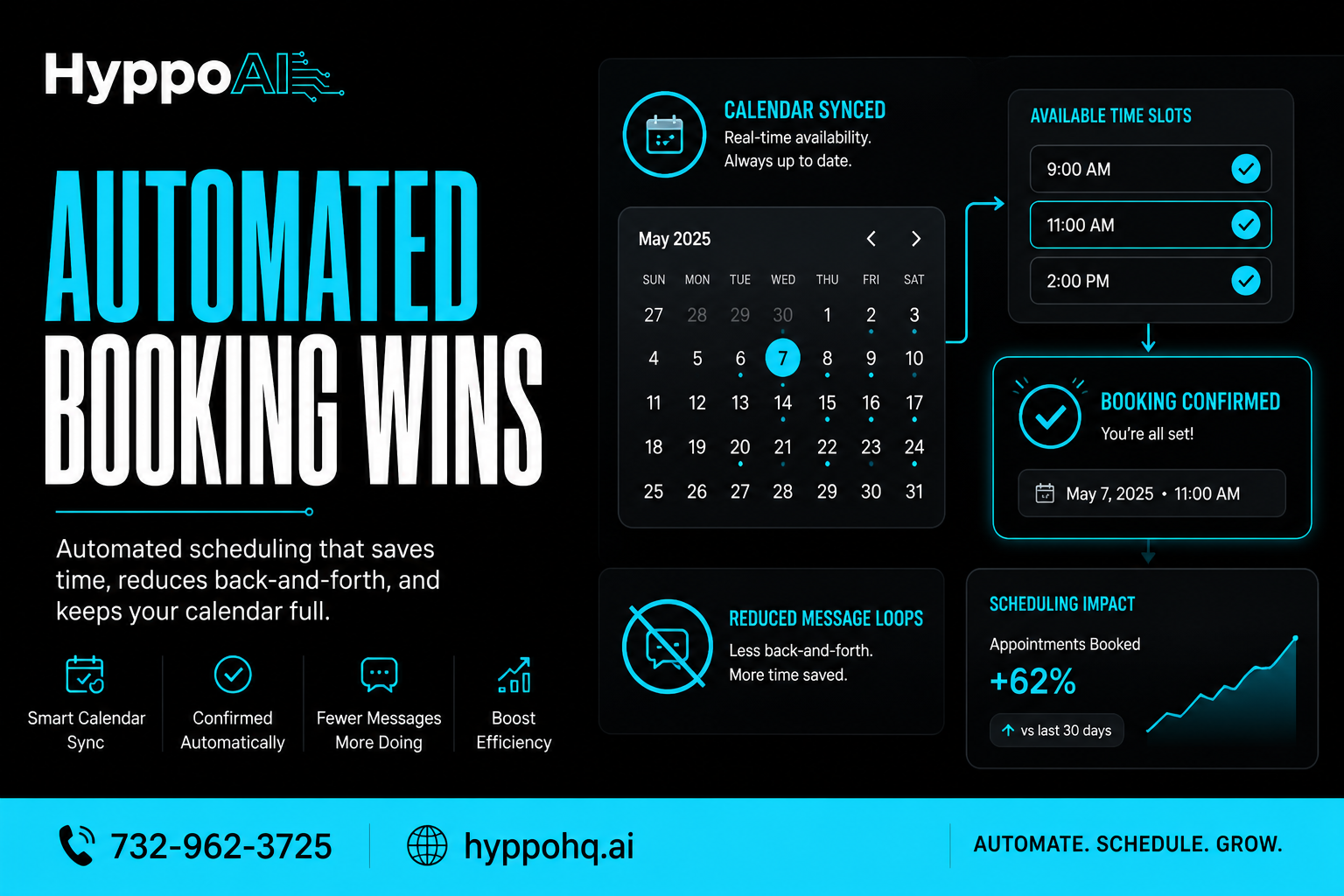
Automated booking reduces back-and-forth for SMB teams
Scheduling should be simple. But for many small and midsize businesses, booking still turns into a long chain of emails, missed calls, text follow-ups, and calendar confusion.
That back-and-forth costs more than time. It slows down sales, frustrates customers, and pulls your team away from work that actually moves the business forward. Automated booking solves that by turning a manual process into a fast, consistent system.
Why scheduling friction hurts growing businesses
Every extra message in the booking process creates drag.
A prospect asks for availability. Your team replies later. The customer is no longer free at that time. Another message goes out. Then a reschedule request comes in. Meanwhile, someone forgets to update the calendar, or a lead never confirms.
This is common in SMBs because teams are lean. One person may be handling operations, customer service, and sales at the same time. When scheduling depends on manual follow-up, delays are almost guaranteed.
Common problems caused by manual booking include:
- Slow response times
- Missed opportunities after hours
- Double-bookings or calendar conflicts
- More inbound calls just to confirm details
- Staff time lost on repetitive admin work
- A poor first impression for new leads
Even if each booking only takes a few minutes, that time adds up quickly across a week or month.
What automated booking actually does
Automated booking lets customers choose a time, confirm details, and get reminders without needing repeated human intervention.
Instead of emailing back and forth, the system handles the steps automatically based on your availability and rules.
Core functions of automated booking
A good automated booking setup can:
- Show real-time availability
- Let customers self-schedule online
- Route bookings to the right person or service
- Send confirmation messages instantly
- Trigger reminders by text or email
- Handle reschedules and cancellations
- Sync with calendars to avoid conflicts
The result is a smoother process for both your team and your customers.
How automated booking reduces back-and-forth
The biggest win is simple: fewer manual touchpoints.
When the booking flow is clear and immediate, customers do not need to wait for someone to reply. They can take action right away.
1. It removes the "what time works?" loop
This is the most obvious source of scheduling friction. Automated booking shows available slots upfront, so the customer picks a time that already works.
There is no need for:
- Suggesting multiple time windows
- Waiting for a response
- Revising options after a delay
- Manually checking calendars
That alone can cut several messages from every appointment.
2. It reduces phone and inbox volume
When people can book, confirm, or reschedule on their own, they do not need to call your office for basic scheduling tasks.
This lowers the volume of repetitive inquiries like:
- "Do you have anything this Thursday?"
- "Can I move my appointment?"
- "Did my booking go through?"
- "What time am I scheduled for?"
Your team spends less time answering routine questions and more time serving customers.
3. It creates faster response times
Manual scheduling only works when someone is available to respond. Automated booking works even when your team is busy, offline, or closed.
That matters because speed influences conversion. If a lead is ready to book now, a delay of even a few hours can cool interest or send them elsewhere.
With automation, the next step is immediate.
4. It standardizes the process
Manual systems vary depending on who is responding. One employee may ask for the right details, another may forget key information, and a third may confirm too late.
Automation creates consistency.
Every customer goes through the same booking flow. That means:
- Fewer mistakes
- Cleaner data capture
- Better calendar accuracy
- A more professional experience
5. It cuts down on no-shows and confusion
Back-and-forth does not end after the booking is made. Customers often need reminders, instructions, or an easy way to update their appointment.
Automated reminders help reduce no-shows by keeping the appointment top of mind. Confirmation messages also make customers feel secure that the booking is set.
Where automated booking helps most
Automated booking is valuable in almost any service-based workflow, especially where speed and convenience matter.
It is often useful for:
- Consultations
- Sales calls
- Discovery calls
- Service appointments
- Demos
- Follow-up meetings
- Intake calls
For SMBs, the biggest impact usually comes in areas where staff are repeatedly interrupted by scheduling tasks.
Business benefits beyond convenience
Automated booking is not just about making calendars easier. It supports operations, customer experience, and growth.
Better customer experience
People want simple next steps. If booking is easy, your business feels easier to work with.
That first interaction shapes trust.
More efficient operations
When scheduling becomes automated, your team can focus on higher-value work instead of repetitive coordination.
Stronger lead capture
A booking system can help move leads from interest to action before momentum is lost.
Improved scalability
As demand grows, manual scheduling becomes harder to manage. Automation helps your process handle more volume without adding the same level of admin effort.
What to look for in an automated booking system
Not every tool or setup delivers the same result. The goal is not just to add a calendar link. The goal is to reduce friction across the full booking journey.
Look for a system that can:
- Match your business hours and availability rules
- Integrate with your existing calendar
- Support reminders and confirmations
- Make rescheduling easy
- Collect the information your team needs in advance
- Fit naturally into your customer workflow
The best setup is one customers barely have to think about.
Automation works best when it fits your process
Some businesses need simple self-scheduling. Others need a more advanced workflow that qualifies leads, routes requests, or connects booking to broader automation.
That is where strategy matters.
If your current process still depends on too many manual steps, automated booking can help remove the friction points that slow down growth. The objective is not to automate for the sake of it. It is to make the experience faster, cleaner, and easier for everyone involved.
Final thoughts
Automated booking reduces back-and-forth by replacing delays, repeated messages, and manual coordination with a clear system customers can use instantly.
For SMB teams, that means less admin work, fewer missed opportunities, and a better booking experience from the first interaction.
If you want to simplify scheduling and reduce operational drag, HyppoAI helps businesses build smarter automation systems. Visit https://hyppohq.ai or call +17329623725 to learn more.
