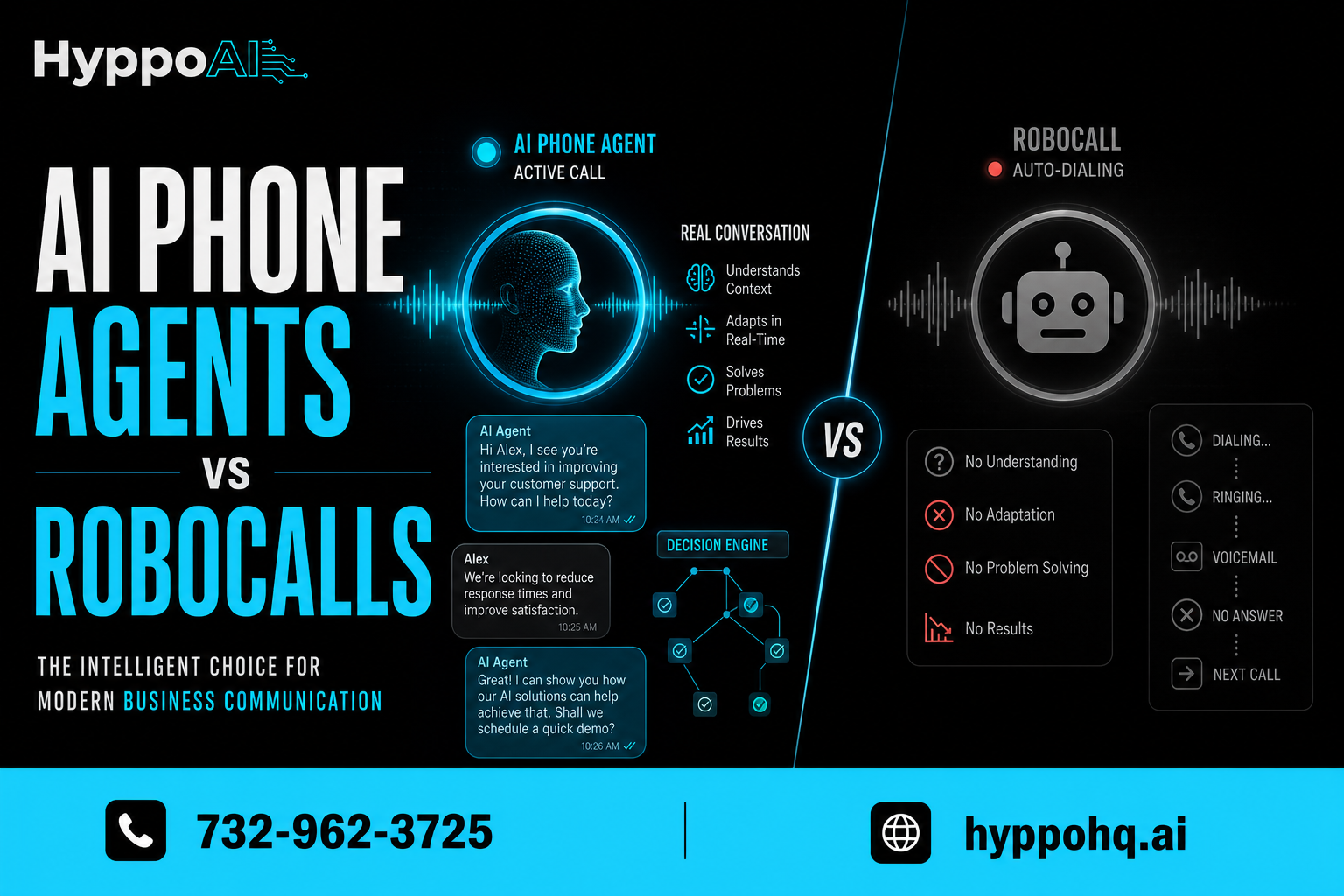
AI phone agents vs robocalls: What makes them different
If you’ve ever received a spammy recorded call, it’s easy to assume every automated voice system works the same way.
It doesn’t.
That confusion is one reason many businesses hesitate to explore voice automation. They hear “AI phone agent” and think “robocall.” But the two are built for very different purposes, use different technology, and create very different customer experiences.
For small and midsize businesses, understanding that difference matters. The right AI phone agent can help you answer more calls, qualify leads faster, route customers correctly, and reduce missed opportunities. A robocall does none of that well.
The short answer: robocalls broadcast, AI phone agents interact
A robocall is usually a one-way, pre-recorded message sent at scale. It follows a script and offers little to no real conversation.
An AI phone agent is designed for two-way interaction. It listens, understands context, responds in real time, and helps move the caller toward an outcome.
That outcome might be:
- booking an appointment
- answering common questions
- routing a caller to the right person
- capturing lead details
- handling after-hours inquiries
- following up when your team can’t answer immediately
The difference is not just technical. It changes how customers experience your business.
What a robocall typically does
Robocalls are usually built for mass outreach. They often:
- play a recorded message
- ask the caller to press a number
- follow a rigid phone tree
- provide little personalization
- fail when a caller goes off-script
In many cases, robocalls create friction. People recognize the pattern quickly and tune out. That’s because the system is not really “thinking” or adapting. It’s just replaying a message or moving through a fixed workflow.
For businesses focused on service, support, or lead conversion, that approach can hurt more than it helps.
What an AI phone agent does differently
AI phone agents are built to handle live conversations more naturally. Instead of forcing every caller through the exact same script, they can respond based on what the person actually says.
1. They support real-time, two-way conversation
This is the biggest difference.
An AI phone agent can listen to a caller’s request and respond in a way that fits the situation. If someone says, “I need to reschedule my appointment,” the agent can recognize the intent and continue the conversation. If another caller says, “I’m calling about pricing,” the response can shift accordingly.
That’s a completely different experience from hearing a generic recorded message.
2. They can understand intent, not just button presses
Traditional robocalls often depend on keypad inputs like “Press 1 for sales.” AI phone agents can go further by interpreting spoken language.
That means callers can explain what they need in their own words. The system can then:
- identify the reason for the call
- ask follow-up questions
- collect relevant information
- route the caller more accurately
For SMBs, that can reduce wasted time for both staff and customers.
3. They can personalize the interaction
Robocalls are usually one-size-fits-all. AI phone agents can be configured around your business workflows, hours, services, and common customer questions.
That makes the interaction feel more useful and less generic.
Examples of personalization include:
- referencing business hours
- answering service-specific FAQs
- capturing caller details for follow-up
- routing based on department or need
- adapting language based on the caller’s request
Personalization is what turns automation from an annoyance into an operational advantage.
4. They help businesses handle missed calls better
One of the biggest pain points for SMBs is the missed call.
When no one answers, the opportunity often disappears. A robocall doesn’t solve that problem. An AI phone agent can.
It can step in when your team is busy, after hours, or unavailable, helping ensure callers still get a response. That can mean:
- fewer lost leads
- better first-response coverage
- improved customer experience
- more consistent intake
For businesses where every inbound call matters, this is a major difference.
5. They fit into business operations
Robocalls are often standalone outreach tools. AI phone agents are more useful when they support actual operations.
They can be part of a broader process for:
- lead capture
- appointment scheduling
- call routing
- follow-up workflows
- customer support triage
That’s why businesses should evaluate them as systems tools, not just call tools.
Why people confuse AI phone agents with robocalls
The confusion is understandable. Both involve automation, voice, and phone calls.
But the label “automated call” hides an important distinction: whether the system is broadcasting or conversing.
People often assume all voice automation is impersonal because older systems trained them to expect poor experiences. Long hold trees, repetitive menus, and spam outreach created that bias.
Modern AI voice systems aim to solve a different problem. They are meant to help businesses respond faster and more consistently without making every interaction feel mechanical.
What businesses should look for in an AI phone agent
If you’re considering voice automation, don’t just ask whether it can answer calls. Ask whether it can support the actual customer journey.
Look for these capabilities
- natural two-way conversation
- accurate intent recognition
- clear routing logic
- lead capture and qualification
- after-hours coverage
- customizable responses for your business
- escalation paths to a human when needed
Also ask practical questions
- What happens when the caller asks something unexpected?
- Can the system collect useful details without sounding robotic?
- Does it reduce missed opportunities?
- Does it improve speed to response?
- Can it align with how your team already works?
The goal is not to automate for the sake of automation. The goal is to create a better process.
The business impact: better service, not more noise
The real value of an AI phone agent is not that it sounds impressive. It’s that it helps your business operate more effectively.
Done right, it can:
- answer calls consistently
- reduce response gaps
- improve lead handling
- support staff during busy periods
- create a more professional caller experience
That is the opposite of what most people associate with robocalls.
Robocalls add noise. AI phone agents should reduce friction.
Final takeaway
A robocall is usually a static message pushed out at scale. An AI phone agent is a dynamic system designed to listen, respond, and help move a conversation forward.
That difference matters for customer trust, operational efficiency, and lead conversion.
If your business depends on inbound calls, the question is not whether automation exists. The question is whether the automation you choose actually improves the experience.
If you want to explore how AI phone agents can support your business, visit HyppoAI at https://hyppohq.ai or call +17329623725 to learn more.
