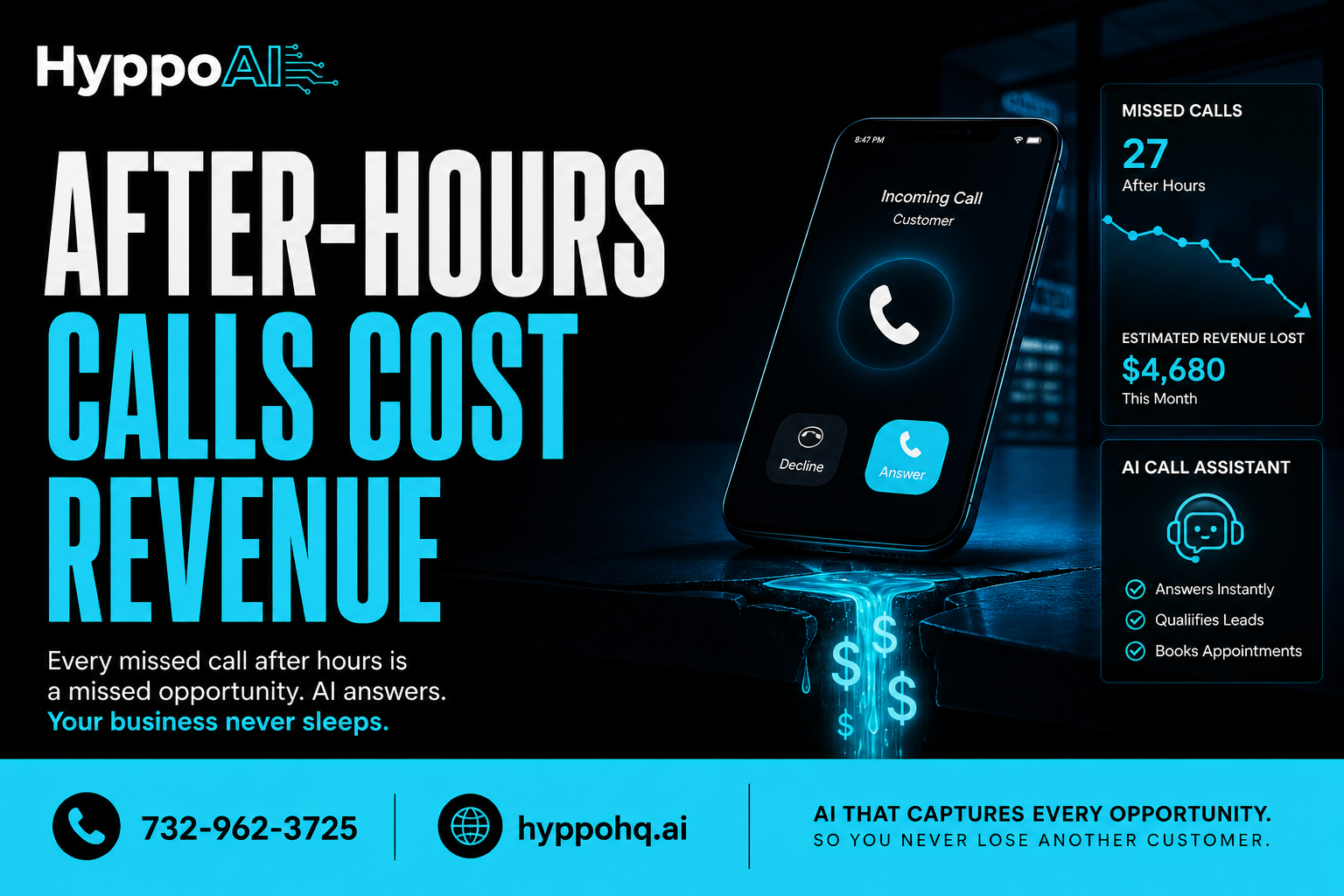
After-hours calls and lost revenue: What most SMBs miss
After-hours calls are easy to overlook because they happen when your team is off the clock. But for many small and midsize businesses, those missed calls create a quiet revenue leak that adds up faster than expected.
If a prospect calls in the evening, on a weekend, or during a holiday and gets voicemail, the opportunity rarely waits until morning. People move on. They call the next provider. They book with the company that answers first.
That means after-hours calls do not just affect convenience. They affect lead capture, conversion rates, customer trust, and long-term revenue.
Why after-hours calls matter more than most owners think
Many business owners track ad spend, website traffic, and close rates. Fewer track what happens when someone calls outside business hours.
That gap matters because intent is often highest when someone picks up the phone. A call usually signals urgency, interest, or readiness to buy. When no one answers, that momentum disappears.
Here is what a missed after-hours call can really mean:
- A new lead never enters your pipeline
- An existing customer chooses a competitor
- An urgent service request goes elsewhere
- A high-value job is lost before your team can respond
- Your brand appears unavailable or disorganized
The loss is not always obvious in your reports. You may simply notice slower growth, lower booking rates, or inconsistent lead quality without realizing after-hours call handling is part of the problem.
The hidden ways missed calls reduce revenue
The financial impact of after-hours calls is not limited to one missed sale. It often creates a chain reaction across your business.
1. You lose high-intent leads
People who call are usually further along than people who casually browse a website. They have a question, a need, or a decision to make. If they cannot reach someone, many will not try twice.
Even if they leave a voicemail, the delay works against you. By the time your team calls back, the lead may already be booked elsewhere.
2. Speed-to-lead drops sharply
Fast response times improve conversion. That is true in nearly every service business. After-hours gaps create the opposite effect.
A delayed callback the next morning may feel reasonable internally, but from the customer's perspective, it can feel slow. In competitive markets, slow often means lost.
3. Customer trust weakens
Availability influences perception. When callers cannot get help, they may assume your business is too busy, too small, or not operationally reliable.
That perception can hurt even if your service is excellent. First impressions matter, and after-hours communication is part of that experience.
4. Marketing ROI gets diluted
If you are paying for SEO, ads, social media, or referral generation, every missed call lowers the return on that investment.
You already spent money to create demand. Failing to capture calls after hours means part of that budget is effectively wasted.
5. Your team starts every day behind
When calls pile up overnight, mornings become reactive. Staff spend time listening to voicemails, returning calls, and sorting urgency instead of moving straight into productive work.
That creates friction across scheduling, sales, and customer service.
Why this problem is easy to underestimate
After-hours revenue loss is often invisible because it does not show up as a clear line item.
You do not see a report labeled revenue lost from voicemail. Instead, it shows up indirectly:
- Lower close rates than expected
- Fewer booked appointments from existing lead volume
- Inconsistent month-to-month sales
- Complaints about slow response times
- Staff overwhelmed by callbacks
Without a system to measure missed calls and outcomes, it is easy to assume the issue is minor. In reality, even a handful of missed high-value calls each week can have a meaningful impact over a month or quarter.
Which businesses are hit hardest
Any SMB that depends on inbound calls should pay attention, but the effect is especially strong for service-based businesses where urgency drives action.
Examples include:
- Home services
- Medical or wellness practices
- Legal offices
- Contractors
- Automotive services
- Property management teams
- Local professional services
In these industries, callers often want immediate answers about availability, pricing, next steps, or emergencies. If they do not get them, they keep moving.
What a better after-hours process looks like
Fixing the problem does not always mean hiring more staff or extending office hours. It means building a reliable system that captures demand when it happens.
A stronger after-hours process should aim to:
- Answer every call consistently
- Gather caller details accurately
- Qualify intent or urgency
- Route emergencies correctly when needed
- Book appointments or collect next-step information
- Create a smooth handoff for your team the next day
This is where automation can make a measurable difference.
How AI can close the after-hours revenue gap
AI voice systems and AI receptionists help SMBs respond to calls when live staff are unavailable. Instead of sending callers straight to voicemail, businesses can provide an immediate, structured response.
That can improve both customer experience and operational efficiency.
What AI can help with
Depending on the setup, an AI-powered call workflow can:
- Answer calls 24/7
- Respond with consistent business information
- Capture names, phone numbers, and service needs
- Identify urgent requests
- Route messages based on priority
- Support appointment booking workflows
- Reduce the number of lost opportunities after hours
The goal is not to replace your team. The goal is to make sure your business stays responsive when your team is unavailable.
Simple questions to audit your current setup
If you want to understand whether after-hours calls are affecting revenue, start with a few practical questions:
Call handling
- What happens when someone calls after closing time?
- Do callers reach voicemail, a live service, or an automated system?
- How often are after-hours calls abandoned?
Follow-up speed
- How quickly are voicemails returned the next day?
- How many callers answer when your team calls back?
- How many of those leads are already gone?
Conversion visibility
- Do you track missed calls as lost opportunities?
- Can you estimate the average value of a missed inbound call?
- Are you connecting call handling to marketing ROI?
Even rough answers can reveal whether there is a meaningful gap.
The real takeaway
After-hours calls affect revenue because customer intent does not follow your office schedule. When your business is unavailable at the moment someone is ready to act, revenue can disappear quietly and repeatedly.
Most owners do not notice the full impact right away. They just feel the downstream effects in slower growth, weaker conversion, and missed opportunities.
The businesses that win are often not the ones with the biggest budgets. They are the ones with the most reliable systems for capturing and responding to demand.
If your business depends on inbound calls, after-hours coverage is not just a customer service issue. It is a revenue protection issue.
If you want to explore how AI can help your business capture more calls after hours, HyppoAI can help you build a smarter response system. Visit https://hyppohq.ai or call +17329623725 to learn more.
